
Private Label
Roll-on Deodorant
AKTO develops and manufactures roll-on deodorant to order — an odour-control product, with no antiperspirant claim and no aluminium or zirconium salts.
- ISO 22716 GMP
In brief
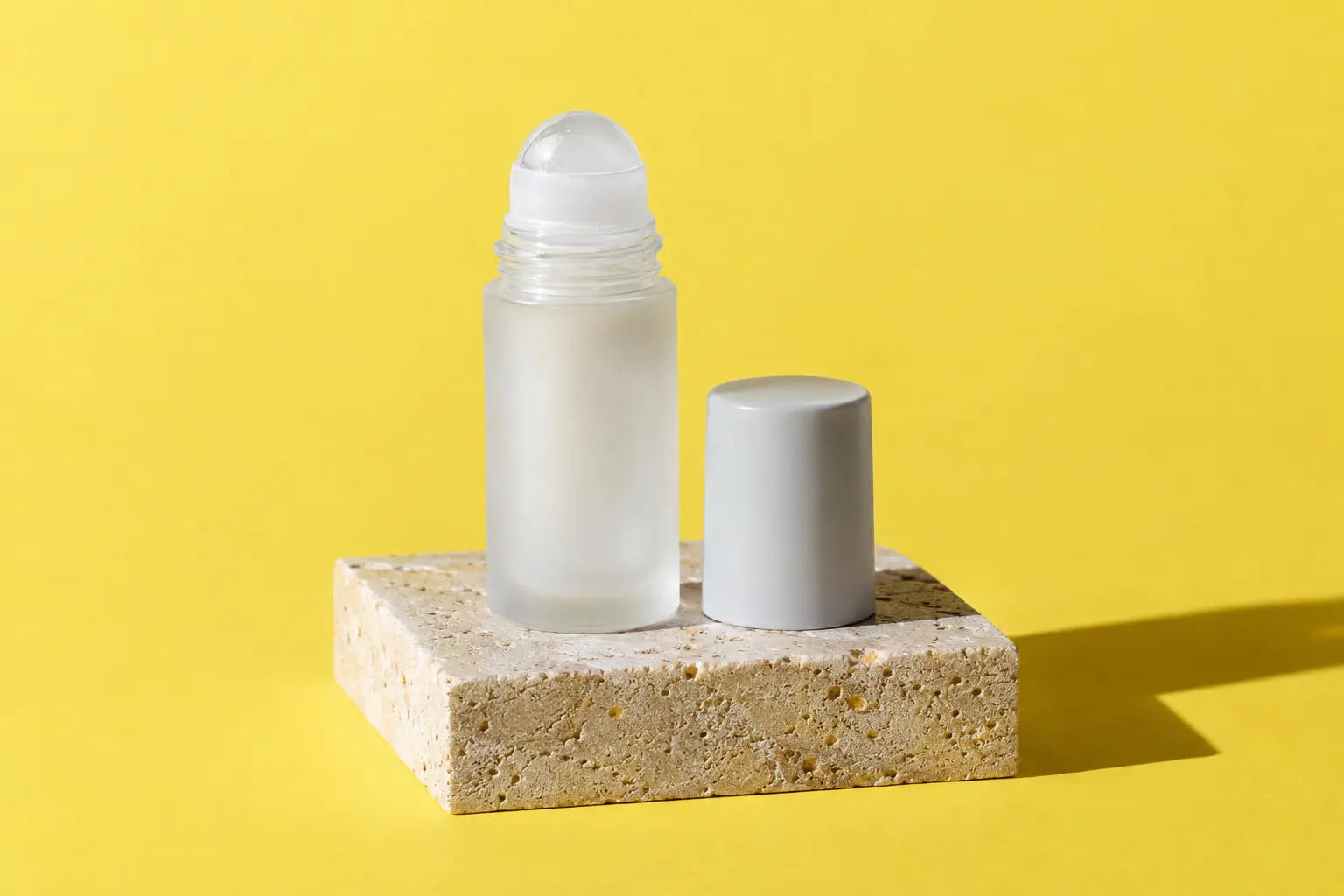
AKTO develops and manufactures a roll-on deodorant to order in a ball-applicator bottle — a product that controls sweat odour rather than blocking sweat itself: aluminium or zirconium salts, typical of an antiperspirant, are not claimed in this format. The formula undergoes a safety assessment under Article 10 of Regulation (EC) No 1223/2009. MOQ is from 50 kg, made in Kyiv (Ukraine) and Warsaw (Poland).
01
What a roll-on deodorant is, and how it differs from an antiperspirant
A roll-on deodorant controls sweat odour — neutralising it or limiting the bacteria that cause it — without reducing perspiration itself. That is the key distinction from an antiperspirant, whose action relies on aluminium or zirconium salts and is claimed specifically against hyperhidrosis; AKTO's deodorant line makes no such claim. Brands launching a roll-on format target an audience looking for a daily odour-control product without a stick or a spray.
02
Formulation, form and packaging requirements
Directive 75/324/EEC defines an "aerosol dispenser" as a non-reusable container holding a gas compressed, liquefied or dissolved under pressure with a release device; a roll-on's mechanically-applied ball dispenser uses no propellant gas and therefore falls outside the Directive's scope. Annex II to Regulation (EC) No 1223/2009 limits the substances suitable for the odour-control active and the fragrance. AKTO checks a chosen active against Annex III of the Regulation and the biocide-regulation boundary at the development stage, following AKTO's own brief-to-shipment process.
03
EU and Ukraine regulatory requirements
A finished cosmetic product such as a roll-on deodorant is outside Regulation (EC) No 1272/2008 on classification and labelling (CLP) — its label is governed by Regulation (EC) No 1223/2009 instead; if the formulation contains ethanol, however, transporting the bulk liquid to the filling line is subject to ADR/IATA dangerous-goods rules. Article 10 of Regulation (EC) No 1223/2009 requires a safety-assessment report before a deodorant reaches the EU market. In Ukraine, the label must carry the responsible person, the manufacturer, the PAO shelf-life symbol and the batch number, per AKTO's own marking-requirements reference for cosmetic and perfumery products.
04
What AKTO offers
AKTO develops and manufactures a roll-on deodorant to order in a ball-applicator bottle, checking the chosen odour-control active against Annex III and the biocide-regulation boundary before formulation begins. MOQ is from 50 kg of finished formulation, made at AKTO's facilities in Kyiv (Ukraine) and Warsaw (Poland). Production is certified to ISO 9001:2015 and ISO 22000:2018 (combined certificate No. 44600111204), ISO 22716 (GMP). Both facilities let a brand pick the site that best matches its target export market.
05
Getting started
A brand sets the odour-control active, the fragrance profile and the target market; AKTO develops the formula from scratch, runs the safety assessment under Article 10 of Regulation (EC) No 1223/2009, and prepares labelling with every mandatory element for the Ukrainian market.
06
See also
See also: Deodorants / Antiperspirants, Deodorant Spray Mist and Cream Deodorant.
Frequently Asked Questions
Does AKTO manufacture a roll-on deodorant?
Is this an antiperspirant?
Is a roll-on deodorant regulated as an aerosol?
What safety check does AKTO's deodorant go through before entering the EU market?
Expert review
Reviewed by
 Illia Mariutsa
Researcher, organic chemistry
Google Scholar Anastasiia Bespalova
Paediatric orthopaedic and trauma surgeon
ORCID
Standards we work to
 ISO 22716 (GMP)
 ISO 22000 (HACCP)
 Regulation (EC) No 1223/2009
 Directive 2002/46/EC
 Halal
Why AKTO
- Roll-on deodorant developed and manufactured to order
- Clear deodorant/antiperspirant boundary — no aluminium or zirconium salts
- Active checked against Annex III and biocide rules before development
- MOQ from 50 kg, facilities in Kyiv (Ukraine) and Warsaw (Poland)
- ISO 22716 (GMP), ISO 9001+22000