
Private Label
Face Scrub
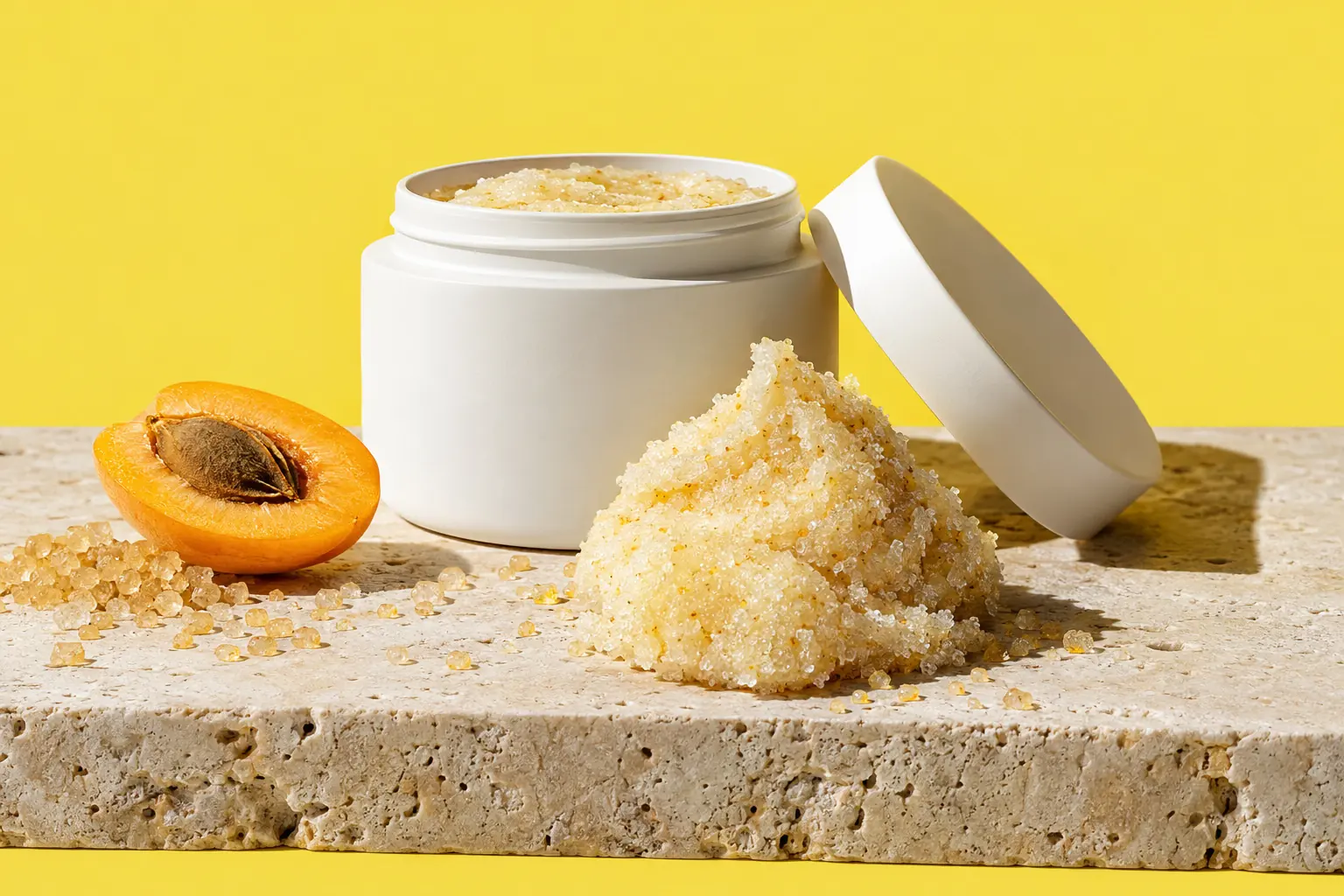
AKTO already manufactures a sugar scrub for mechanical face exfoliation, filled into a 250 g jar.
- ISO 22716 GMP
In brief
Company AKTO LLC (AKTO) already manufactures a sugar scrub for mechanical face exfoliation - a natural carbohydrate abrasive, not a synthetic microplastic - filled into a 250 g jar. This format falls outside the ban on synthetic microbeads under Regulation (EU) 2023/2055, in force since 17 October 2023.
01
Mechanical exfoliation: how a scrub works
A scrub cleans the skin mechanically: solid particles suspended in a cream or gel base lift away dead cells during massage, unlike an acid or enzyme peel, which works chemically. Brands launch a scrub as a separate format for customers who avoid acids, or alongside an acid range for combined care. Because the effect is felt immediately on application, it is a visually demonstrable product that works well in marketing materials and on social media.
02
The formula AKTO manufactures
AKTO manufactures a sugar scrub - a natural carbohydrate abrasive rather than a synthetic microbead - filled into a 250 g jar. This packaging differs from the dropper bottles and tubes AKTO uses for the chemical acid peels in the same range. The scrub's oil/wax carrier phase goes through the same physicochemical stability testing as AKTO's other emulsion formats.
03
Microplastics and regulatory requirements
Regulation (EU) 2023/2055, which inserted the restriction into REACH Annex XVII entry 78, entered into force on 17 October 2023 and immediately - with no transitional period - banned synthetic-polymer microbead abrasives used for exfoliating, polishing or cleaning in cosmetics, since industry had already been expected to phase them out voluntarily by 2020; other rinse-off cosmetics containing non-abrasive synthetic microplastics get a transitional period until 17 October 2027. AKTO's sugar abrasive, a natural carbohydrate, falls outside this restriction. Articles 3 and 10 of Regulation (EC) No 1223/2009, on general safety and the safety assessment, apply to a scrub regardless of the abrasive used, and Annex I Part A Section 5 requires the intended use to be justified in light of the label's warnings.
04
AKTO's production capability
The minimum batch is 50 kg of finished formulation at AKTO's facilities in Kyiv (Ukraine) and Warsaw (Poland). The testing package includes physicochemical analysis and stability testing, applicable to the scrub's oil/wax carrier phase. AKTO already documents two chemical acid-exfoliation textures - serum and emulsion - so the sugar scrub gives a brand a choice between chemical and mechanical exfoliation within one range. Production is certified to ISO 9001:2015, ISO 22000:2018 (HACCP; combined certificate No. 44600111204) and ISO 22716 (GMP).
05
Getting started
A brand sets the target abrasiveness, fragrance and jar format; AKTO adapts the scrub recipe for the brand, runs physicochemical stability testing and prepares the technical documentation for the chosen market. Both facilities, in Kyiv (Ukraine) and Warsaw (Poland), let a brand pick a production site to match its target market. See also: Exfoliation / Peels (Face), Face Enzym Peel, Face Exfoliating Peel (AHA) and Face Exfoliating Peel (BHA).
Frequently Asked Questions
What is AKTO's face scrub made from?
Does the sugar scrub fall under the EU microplastics ban?
When did the EU ban on abrasive microbeads in cosmetics take effect?
What packaging does AKTO use for the face scrub?
Expert review
Reviewed by
 Illia Mariutsa
Researcher, organic chemistry
Google Scholar Anastasiia Bespalova
Paediatric orthopaedic and trauma surgeon
ORCID
Standards we work to
 ISO 22716 (GMP)
 ISO 22000 (HACCP)
 Regulation (EC) No 1223/2009
 Directive 2002/46/EC
 Halal
Why AKTO
- Sugar scrub, a natural carbohydrate abrasive
- 250 g jar, distinct from the chemical-peel packaging
- Falls outside the Regulation (EU) 2023/2055 microbead ban
- Choice of chemical or mechanical exfoliation in one range
- MOQ from 50 kg, facilities in Kyiv (Ukraine) and Warsaw (Poland)