
Private Label
Facial Serum (Brightening)
AKTO develops and manufactures a brightening facial serum to a brand's brief around niacinamide, already used in its own cream, plus its proven AHA/PHA acid serum.
- ISO 22716 GMP
In brief
Company AKTO LLC (AKTO) develops and manufactures a brightening facial serum to a brand's brief, combining niacinamide — already used in AKTO's day cream and cream-mask — with its proven liquid serum on AHA and PHA acids, which add a mild resurfacing effect of their own. Production follows Regulation (EC) No 1223/2009 and ISO 22716.
01
What a brightening facial serum is
A brightening serum evens out skin tone, fades pigment spots and leaves the face looking more uniform and radiant — one of the most requested formats in the tone-care segment. Unlike an acid serum, which targets surface texture, a brightening product works primarily on color evenness and is often positioned for daily rather than course-based use. Visible effect is usually assessed over several weeks of regular use, so a brand tends to keep pack claims measured rather than promising an instant result.
02
Actives, format and packaging
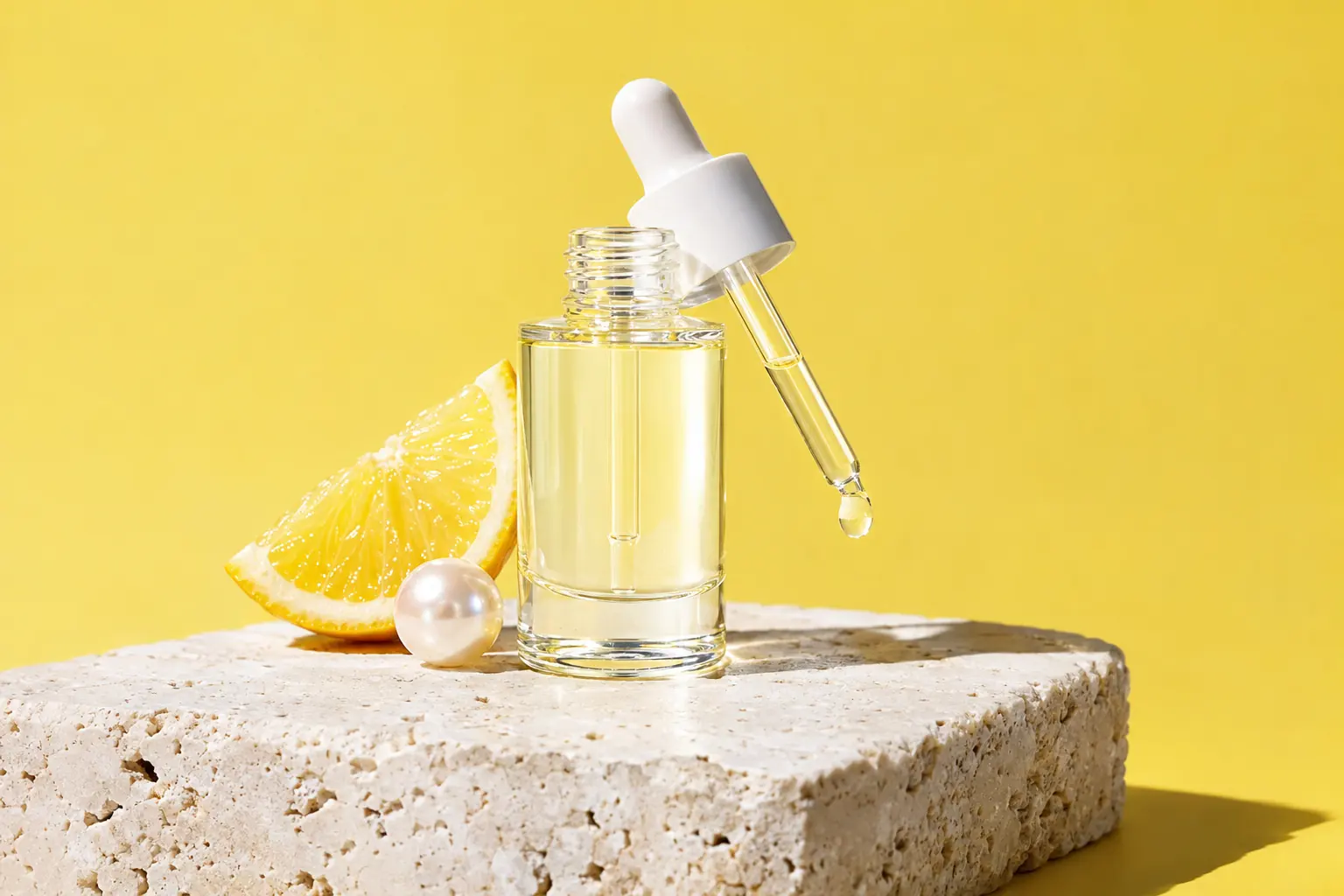
Niacinamide — the key brightening and barrier-support active — is already used in AKTO's day-cream formula alongside sodium hyaluronate and ceramides, and in its anti-inflammatory cream-mask alongside D-Panthenol and black cumin oil. AKTO manufactures a liquid serum on a complex of AHA and PHA acids, filled into 50 ml and 100 ml dropper bottles — these acids add a mild brightening and resurfacing effect of their own, so a brightening serum version is built by pairing niacinamide with this liquid base to a brand's brief. The combination lets a brand position one product as both a tone-evening treatment and a light exfoliant, instead of running two separate bottles in the range.
03
EU and Ukraine regulatory requirements
Article 10 of Regulation (EC) No 1223/2009 requires a Cosmetic Product Safety Report before a brightening serum is placed on the EU market, and Article 19 with Annex III sets the fragrance-allergen declaration threshold at 0.001% by weight for a product that stays on the skin. Under Articles 19(1)(g) and 19(6), a brightening active such as niacinamide is named by its common ingredient name under the INCI glossary, in descending order of weight of the ingredients at the time they are added to the cosmetic product. A brightening marketing claim requires substantiation under the common criteria of Regulation (EU) No 655/2013. In Ukraine the product is registered under AKTO's own TU U 20.4-43961492-001:2020.
04
What AKTO offers
The formulation batch for a brightening serum, like AKTO's other cosmetic formulas, starts from 50 kg at its facilities in Kyiv (Ukraine) and Warsaw (Poland). The test package for a new formula covers physicochemical analysis (pH, viscosity, organoleptics) plus stability and compatibility testing. Production meets ISO 9001:2015 and ISO 22000:2018 (HACCP; combined certificate No. 44600111204), ISO 22716 (GMP).
05
Getting started
A brand picks the target effect — tone evenness, pigment fading or added radiance — and AKTO builds the formula around niacinamide and the acid complex, runs physicochemical testing, and prepares the technical documentation for the chosen market. See also: Serums / Ampoules / Concentrates, Facial Serum (Peptides), Facial Serum (Soothing) and Facial Concentrate.
Frequently Asked Questions
Does AKTO manufacture a brightening facial serum?
Where does AKTO already use niacinamide?
Does a brightening claim need substantiation?
What is the minimum batch for a brightening serum?
Expert review
Reviewed by
 Illia Mariutsa
Researcher, organic chemistry
Google Scholar Anastasiia Bespalova
Paediatric orthopaedic and trauma surgeon
ORCID
Standards we work to
 ISO 22716 (GMP)
 ISO 22000 (HACCP)
 Regulation (EC) No 1223/2009
 Directive 2002/46/EC
 Halal
Why AKTO
- Niacinamide already used in the day-cream and cream-mask formula
- Own liquid serum on AHA/PHA acids in 50 ml and 100 ml dropper bottles
- MOQ from 50 kg, facilities in Kyiv (Ukraine) and Warsaw (Poland)
- Niacinamide serum formula backed by physicochemical and stability testing
- Certified to ISO 9001:2015, ISO 22000:2018 (HACCP), ISO 22716 (GMP)