
Private Label
Hand Scrub
AKTO develops and manufactures hand scrub to order on its mechanical-exfoliation line — a 250 g jar format, free of synthetic microplastic abrasives.
- ISO 22716 GMP
In brief
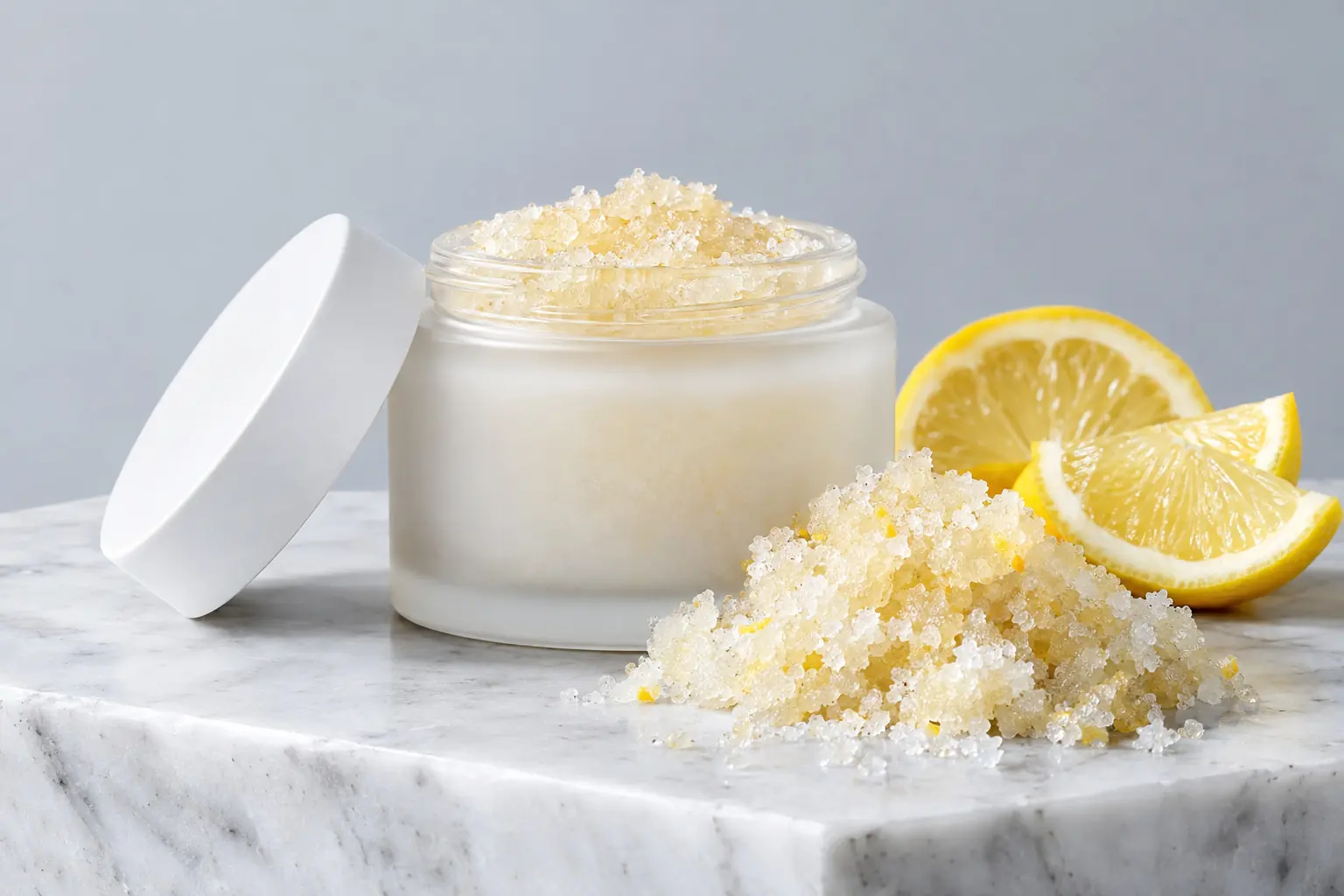
AKTO develops and manufactures a hand scrub to order on its mechanical-exfoliation line, building on its existing granular sugar-based scrub packed in a 250 g jar. The abrasive particles are natural, outside the scope of the synthetic-microplastics ban. Because a hand scrub is rinsed off, its fragrance-allergen labelling threshold is less strict than a cream's. MOQ is from 50 kg, made in Kyiv (Ukraine) and Warsaw (Poland).
01
What a hand scrub is and who needs it
A hand scrub mechanically removes dead skin cells before a cream is applied: a course or occasional item rather than a daily one. Brands position it as a companion to a hand cream in the range — a product that sells well paired with the main care item rather than as a standalone daily ritual.
02
Formulation, form and packaging requirements
AKTO already manufactures a granular sugar-based scrub with a mango and passion-fruit sensory profile in a 250 g jar, evidencing its mechanical-abrasive capability, though the existing product is formulated for the body rather than specifically for hands. Commission Regulation (EU) 2023/2055, amending REACH Annex XVII, has restricted intentionally-added synthetic-polymer microplastics historically used as a scrub abrasive under a phased ban starting 17 October 2023 — AKTO's formula is built on a natural abrasive instead. Annex II to Regulation (EC) No 1223/2009 limits the abrasive and preservative substances available, and Phenoxyethanol, a preservative option for a base exposed to water in the shower, cannot exceed 1.0% under Annex V. Because a hand scrub is a rinse-off product, its fragrance-allergen labelling threshold under Annex III is 0.01% by weight — less strict than the 0.001% that applies to a leave-on cream.
03
EU and Ukraine regulatory requirements
An "exfoliates dead skin" claim on a hand scrub falls under the six common criteria of Commission Regulation (EU) No 655/2013, including truthfulness and evidential support. In Ukraine, the Technical Regulation on cosmetic products (Resolution No. 65) prohibits placing a rinse-off scrub on the market if its final formulation or ingredients were tested on animals using a non-alternative method once a validated alternative method has been adopted (point 46).
04
What AKTO offers
AKTO develops and manufactures a hand scrub to order, building on its existing granular sugar-scrub formula; a 250 g jar is the existing format, and a tube is also technically feasible for a hand-specific version. MOQ is from 50 kg of finished formulation, made at AKTO's facilities in Kyiv (Ukraine) and Warsaw (Poland). Production is certified to ISO 9001:2015 and ISO 22000:2018 (combined certificate No. 44600111204), ISO 22716 (GMP).
05
Getting started
A brand sets the abrasive's sensory profile, the jar or tube size and the target exfoliation claim; AKTO adapts its existing natural-abrasive granular formula or develops a new one, assembles the evidence against the Regulation (EU) No 655/2013 criteria, and prepares registration under Resolution No. 65.
06
See also
See also: Hands & Feet, Foot Scrub, Barrier Hand Cream and Repairing Hand Cream.
Frequently Asked Questions
Does AKTO manufacture a hand scrub?
Does AKTO's scrub contain microplastics?
What packaging can a hand scrub use?
How does the allergen labelling threshold differ from a cream?
Expert review
Reviewed by
 Illia Mariutsa
Researcher, organic chemistry
Google Scholar Anastasiia Bespalova
Paediatric orthopaedic and trauma surgeon
ORCID
Standards we work to
 ISO 22716 (GMP)
 ISO 22000 (HACCP)
 Regulation (EC) No 1223/2009
 Directive 2002/46/EC
 Halal
Why AKTO
- Existing granular sugar-based scrub formula
- Hand scrub developed and manufactured to order
- Natural abrasive, outside the 2023/2055 microplastics ban
- MOQ from 50 kg, facilities in Kyiv (Ukraine) and Warsaw (Poland)
- ISO 22716 (GMP), ISO 9001+22000