
Private Label
Limescale Remover
AKTO develops and manufactures an acid-based limescale remover to order, checking the formula's hazard classification under the CLP Regulation.
- CLP 1272/2008
In brief
A limescale remover dissolves calcium-carbonate deposits already built up on tile, taps and fixtures, using an acid - a mild organic one such as citric acid, or a stronger one. Under Regulation (EC) No 1272/2008 (CLP) Annex I, an acid at pH 2 or below is classified Skin Corr. 1 / Eye Dam. 1 in the absence of other information. In Ukraine, the Technical Regulation on Detergents (CMU Resolution No. 717/2008) applies only once soap or surfactant content exceeds 0.2%. AKTO develops and manufactures this product to order in a 250 ml trigger-spray bottle or a 500 ml pump-jar, from a 50 kg batch.
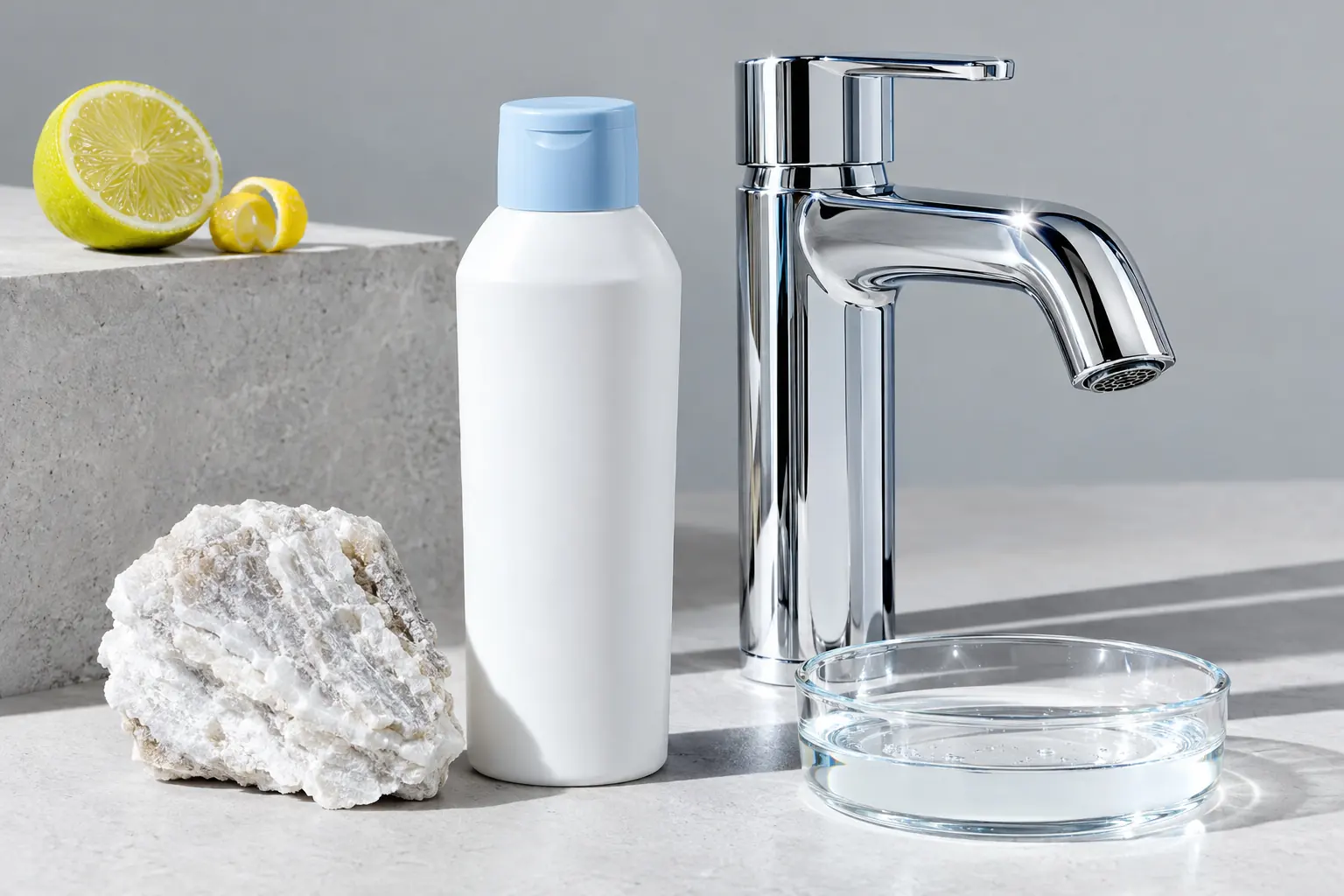
01
What a limescale remover is
Company AKTO LLC (AKTO) develops and manufactures a limescale remover to order. Unlike a daily preventive shower spray, this product dissolves calcium-carbonate deposits that have already formed on tile, taps, chrome fixtures and glass, so the formula typically relies on an acid rather than surfactants alone. A brand positions it as a stronger, occasional-use companion to a daily spray, for the buildup that everyday prevention no longer removes.
02
Hazard classification under CLP
Regulation (EC) No 1272/2008 (CLP) does not classify every acid-based cleaner as corrosive: under Annex I (sections 3.2 and 3.3), a strong acid at pH 2 or below is treated as Skin Corr. 1 / Eye Dam. 1 in the absence of other information on acid reserve, while at other pH values classification depends on the concentration of the specific classified acid in the formula. Citric acid, a mild organic acid commonly used to dissolve calcium carbonate, carries a majority classification of H319 (serious eye irritation, around 85% of notifiers) and a minority H335 (respiratory irritation, around 23%) - a markedly milder profile than a mineral-acid descaler. Article 17 of CLP requires the label of a classified hazardous mixture to show the product identifier, hazard pictograms, signal word, precautionary statements and supplier details.
03
Packaging and Ukraine's regulatory position
The Technical Regulation on Detergents (CMU Resolution No. 717/2008, as amended) applies to a limescale remover as a surface-cleaning detergent only once its soap and/or surfactant content exceeds 0.2% by weight; many purely acid-based descaling formulas fall below that threshold and outside the regulation. AKTO's standard label specification for round bottles calls for a self-adhesive or heat-shrink label supplied as a roll with a 7.5 cm roll diameter, with label height at least 2 mm less than the container height - a specification applicable to a round trigger-spray descaler bottle.
04
What AKTO offers for this category
AKTO develops and manufactures a limescale remover in a 250 ml trigger-spray bottle or a 500 ml pump-jar, from a 50 kg batch of finished formulation at its Kyiv (Ukraine) and Warsaw (Poland) facilities. AKTO argues that producing on a large line across 3 shifts works out cheaper than a small line in a single shift, an economy of scale relevant to a limescale-remover production run. Production runs under the combined ISO 9001:2015 and ISO 22000:2018 (HACCP) certificate (No. 44600111204) and ISO 22716 (GMP).
05
Getting started with AKTO
The brand defines the acid type (mild organic or stronger) and the target surface.
- AKTO checks the formula's pH and hazard classification under CLP.
- For a classified mixture, prepares Article 17 pictogram labelling.
- Agrees the trigger-spray bottle or pump-jar and batch size with the brand.
- Starts series production at the Kyiv (Ukraine) or Warsaw (Poland) plant.
See also: Bathroom / Toilet / Pipes, Daily Shower Spray, Rust Remover and Home Care & Cleaning.
Frequently Asked Questions
Does AKTO manufacture a finished limescale remover?
Is an acid-based limescale remover always classified as corrosive?
How does citric acid compare in hazard to a mineral acid?
When does the Technical Regulation on Detergents apply to a limescale remover?
 Kateryna Khromykh
 Oleksandra Vovk
Standards we work to
 ISO 22716 (GMP)
 ISO 22000 (HACCP)
 Regulation (EC) No 1223/2009
 Directive 2002/46/EC
 Halal
Why AKTO
- Development of an acid-based limescale remover to order
- 250 ml trigger-spray bottle or 500 ml pump-jar packaging
- Formula checked for hazard classification under CLP
- Production certified to ISO 22716 (GMP) and the combined ISO 9001/22000 certificate