
Private Label
Rust Remover
AKTO develops and manufactures a rust and metal-stain remover to order, with controlled production conditions and formula hazard classification.
- CLP 1272/2008
In brief
A rust remover dissolves metal-oxide staining on fixtures using an acid that is often stronger than the mild organic acid used in a limescale remover. Regulation (EC) No 1272/2008 (CLP) requires hazard classification based on the acid used: oxalic acid, common for rust removal, has a broader, more severe profile than citric acid. In Ukraine, the Technical Regulation on Detergents (CMU Resolution No. 717/2008) does not apply where surfactant content stays at or below 0.2%. AKTO develops and manufactures this product to order in a 100 ml airless pump bottle, from a 50 kg batch.
01
What a rust remover is
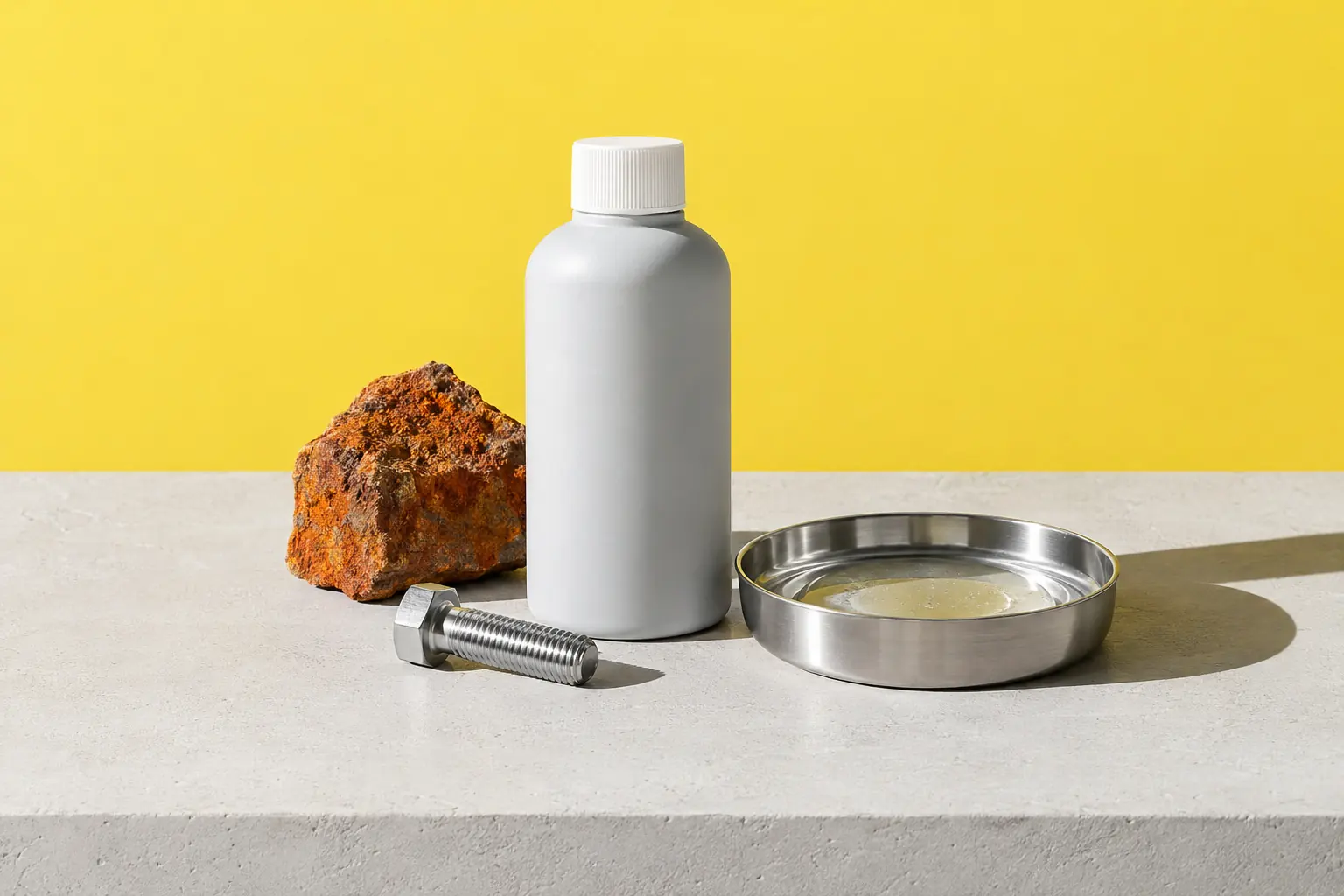
Company AKTO LLC (AKTO) develops and manufactures a rust remover to order. Unlike a limescale remover, which works on calcium-carbonate deposits, a rust remover dissolves metal-oxide staining - the reddish film on taps, drain grates and metal fixtures - so its formula typically relies on a stronger or more acutely toxic acid than the mild organic acid used against limescale. A brand positions it as a specialised product for metal surfaces, separate from everyday tile or glass care.
02
Hazard classification and comparison with other acids
Regulation (EC) No 1272/2008 (CLP) requires a rust remover to be classified according to the hazard profile of the specific acid it contains, and rust removal commonly relies on a stronger or more acutely toxic acid than the mild organic acid used in a limescale remover. Oxalic acid, commonly used to remove rust and metal stains, carries a majority classification of H302 (harmful if swallowed, around 99.8% of notifiers) and H312 (harmful in contact with skin, around 99.7%), with around 31% of notifiers adding H318 (serious eye damage); some other data sources also list H314 and H361 - a broader and more severe hazard profile than the citric acid used in a limescale remover.
03
Ukraine's regulatory position and AKTO's development process
The Technical Regulation on Detergents (CMU Resolution No. 717/2008, as amended) does not apply to an acid-based rust-remover preparation whose soap and/or surfactant content stays at or below 0.2%, regardless of the acid's strength. AKTO develops a new product through an Operational Development Sheet (OLR), then an Operational Production Sheet (OLP) and a raw-material loading table, with a First Production Report (OPP) covering the first 3-5 batches - a process applicable to launching a rust remover. AKTO's production premises are held at 20-60% humidity and 16-25 degC, measured twice per shift.
04
What AKTO offers for this category
AKTO develops and manufactures a rust remover in a 100 ml airless pump bottle, from a 50 kg batch of finished formulation at its Kyiv (Ukraine) and Warsaw (Poland) facilities. Brand-supplied raw materials and packaging components are accepted no later than 5 working days before the production cycle, with quality acceptance completed within 5 working days. Production runs under the combined ISO 9001:2015 and ISO 22000:2018 (HACCP) certificate (No. 44600111204) and ISO 22716 (GMP).
05
Getting started with AKTO
The brand defines the target surface (fixtures, metal grates) and the required acid strength.
- AKTO checks the specific acid's hazard profile under CLP.
- Documents the first sample through an OLR, an OLP and an OPP for the first batches.
- Agrees the 100 ml airless pump bottle and batch size with the brand.
- Starts series production at the Kyiv (Ukraine) or Warsaw (Poland) plant.
See also: Bathroom / Toilet / Pipes, Limescale Remover, Drain Opener (Gel) and Home Care & Cleaning.
Frequently Asked Questions
Does AKTO manufacture a finished rust remover?
Why is a rust remover more hazardous than a limescale remover?
When does the Technical Regulation on Detergents apply to a rust remover?
How does AKTO document the development of a new rust remover?
 Kateryna Khromykh
 Oleksandra Vovk
Standards we work to
 ISO 22716 (GMP)
 ISO 22000 (HACCP)
 Regulation (EC) No 1223/2009
 Directive 2002/46/EC
 Halal
Why AKTO
- Development of a rust remover to order
- 100 ml airless pump bottle, MOQ from 50 kg
- Production premises held at 20-60% humidity and 16-25 degC
- Development documented through OLR, OLP and OPP for the first batches