
Private Label
Lip Scrub
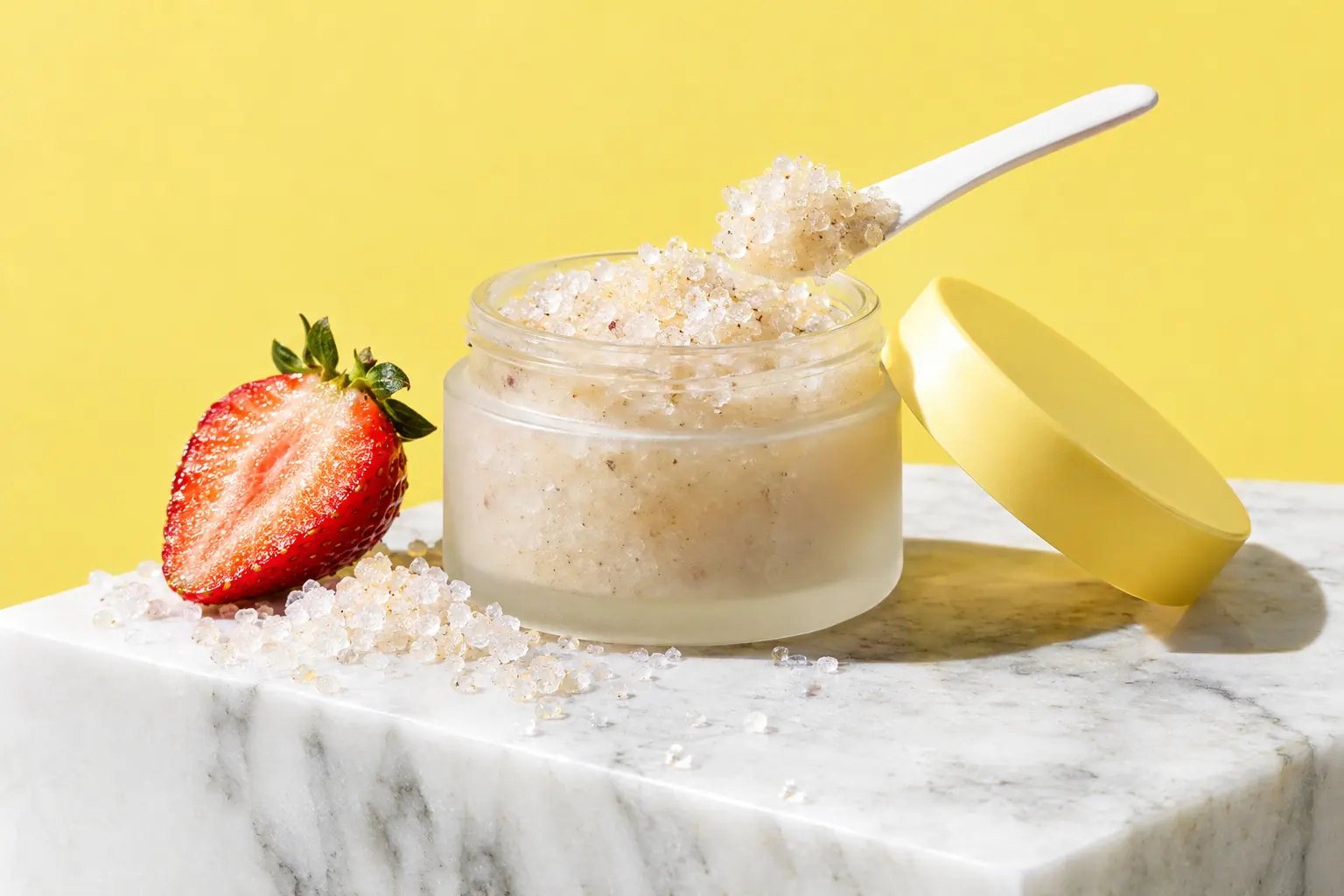
AKTO develops and manufactures a rinse-off lip scrub with abrasive particles, to order on its production lines.
- ISO 22716 GMP
In brief
A lip scrub is a rinse-off paste or emulsion with abrasive particles, used as a preparatory step rather than a daily treatment. AKTO develops and manufactures a lip scrub to order, from a 50 kg minimum batch, packaged in jars or PBL tubes, with exfoliating particles checked against EU microplastics restrictions.
01
The rinse-off step in an otherwise leave-on range
A lip scrub is a paste or emulsion carrying abrasive particles, used briefly to buff away dry, flaking skin before being wiped or rinsed away - the one rinse-off format in a lip-care range built mostly around leave-on products like a cream, a balm or a mask. For a brand, a scrub is usually positioned as a preparatory step, used a few times a week rather than daily, that sets the lips up for a treatment balm or a tinted product to apply more evenly afterward.
02
A more permissive allergen threshold, because it's rinsed off
Regulation (EC) No 1223/2009 defines a "rinse-off product" as one intended to be removed after application; a lip scrub, wiped or rinsed away after exfoliating, is that format. Under Annex III, a fragrance allergen such as Benzyl Alcohol only needs to be named once its concentration exceeds 0.01% in a rinse-off product - ten times more permissive than the 0.001% threshold that would apply to a lip balm or mask left on the skin.
03
Salicylic acid stays at the general ceiling, rinse-off or not
Being rinse-off doesn't move a lip scrub to a higher salicylic-acid allowance: Annex III entry 98 caps it at the general 2.0% ceiling for "other products," because the entry's higher 3.0% rate names only rinse-off hair products specifically, not a rinse-off lip product. A brand should not assume "rinse-off" alone unlocks a higher concentration for an active ingredient without checking the exact wording of the relevant entry.
04
A note on exfoliating particles
Commission Regulation (EU) 2023/2055, amending REACH Annex XVII, restricts intentionally-added synthetic-polymer microplastics historically used as an abrasive in physical scrubs, under a phased ban that began on 17 October 2023. A natural abrasive such as sugar or salt falls outside that synthetic-polymer restriction, which is relevant to a lip scrub's choice of exfoliating particle from the earliest formulation brief.
05
What AKTO offers for a lip scrub
AKTO develops and manufactures a lip scrub to order, packaged in jars of 50-250 g or PBL tubes of 15-50 ml. AKTO's production premises are checked for humidity (20-60%) and temperature (16-25 degrees C) twice per shift, a control relevant to a paste or emulsion-based scrub's stability. The minimum order is a 50 kg batch. ISO 22716:2007's guidelines for production, control, storage and shipment cover a rinse-off, particle-bearing paste the same way as a leave-on emulsion, and manufacturing holds ISO 9001:2015 combined with ISO 22000:2018 (certificate No. 44600111204).
06
Starting a lip scrub project
A brand sets the abrasive type - natural particles such as sugar or salt are a common choice - the texture and the packaging format; AKTO formulates or adapts a scrub to match and prepares the technical file for the target market. A brand can pair this scrub with the cream, balm or mask above as the preparatory step in a full lip-care range.
Frequently Asked Questions
What is a lip scrub, and how is it used?
Why does a lip scrub have a more permissive allergen threshold?
Does being rinse-off allow a higher salicylic-acid concentration in a lip scrub?
What abrasive particles can a lip scrub use?
Expert review
Reviewed by
 Illia Mariutsa
Researcher, organic chemistry
Google Scholar Anastasiia Bespalova
Paediatric orthopaedic and trauma surgeon
ORCID
Standards we work to
 ISO 22716 (GMP)
 ISO 22000 (HACCP)
 Regulation (EC) No 1223/2009
 Directive 2002/46/EC
 Halal
Why AKTO
- Develops and manufactures a lip scrub to order on emulsion/paste production lines
- Packaging in jars 50-250 g or PBL tubes 15-50 ml
- Humidity and temperature monitored twice per shift for formula stability
- ISO 22716 (GMP), ISO 9001:2015 + ISO 22000:2018