
Private Label
Mouthwash
AKTO develops and manufactures mouthwash to order on its own lines in Kyiv (Ukraine) and Warsaw (Poland).
- ISO 22716 GMP
In brief
AKTO develops and manufactures mouthwash to order on its own lines in Kyiv (Ukraine) and Warsaw (Poland). Where the formula contains fluoride, it is capped at 0.15% calculated as F and labelled 'Contains sodium fluoride' - the 'Children of 6 years...' warning required on toothpaste does not apply to mouthwash. Triclosan can no longer be used as a preservative in mouthwash since 24 April 2024. The minimum batch is 50 kg.
01
What mouthwash is
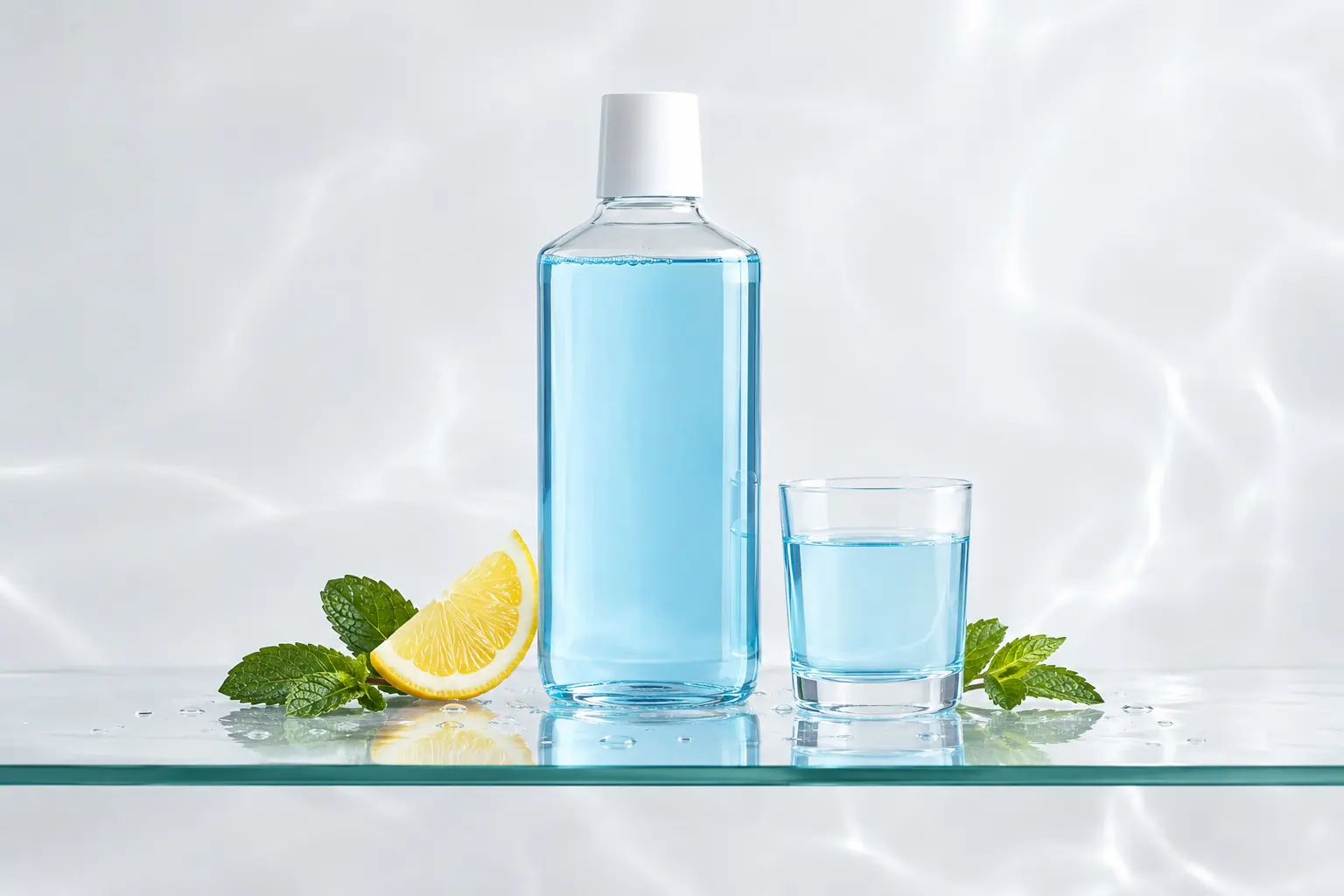
Mouthwash is the liquid format for the final step of oral hygiene: a rinse held in the mouth and spat out, unlike a paste or gel used with a brush. For a brand, it is typically sold as a companion product to a paste - an add-on that lifts the average order value rather than a stand-alone substitute for brushing.
02
Fluoride and labelling that differs from toothpaste
Where a mouthwash contains fluoride, Annex III entry 31 to Regulation (EC) No 1223/2009 caps it at 0.15% calculated as F and requires the label 'Contains sodium fluoride'; the 'Children of 6 years and younger: use a pea-sized amount...' warning, mandatory specifically for toothpaste, is not prescribed for mouthwash - a separate labelling rule for two formats within the same category.
03
Preservatives and the Triclosan ban
Commission Regulation (EU) 2024/996 (published 4 April 2024, in force since 24 April 2024) removed mouthwashes from the product types permitted to use Triclosan as a preservative under Annex V entry 25; non-compliant products could still be placed on the market until 31 December 2024 and made available until 31 October 2025. Triclosan remains allowed at up to 0.3% in toothpaste, hand and body soaps, shower gels, non-spray deodorants, face powders and certain nail products, with the age restriction applying only to toothpaste (not for children under 3). An antibacterial or anti-plaque claim needs supporting evidence under Regulation (EU) No 655/2013.
04
What AKTO offers
Each new formulation, including a new mouthwash, is documented through an OLR (development operating sheet) followed by an OLP (production operating sheet), with a first-production report (OPP) required for the first 3-5 batches of a new formula. Packaging uses flip-top bottles and control-cap bottles at 55 ml, suited to metered dosing of a rinse liquid. Bottle-filling capacity reaches up to 500,000 units a month in Kyiv (Ukraine) and up to 200,000 in Warsaw (Poland). The minimum batch is 50 kg of finished formulation. Production is certified to ISO 9001:2015, ISO 22000:2018 (HACCP; combined certificate No. 44600111204) and ISO 22716 (GMP).
05
Getting started
A brand decides whether to include fluoride or an antibacterial ingredient, the bottle size and the label claims; AKTO prepares the formula, the OLR/OLP documentation and labelling compliant with the current Triclosan rules. This format runs on the same liquid lines as other products in the category, so a brand can add mouthwash to its range without a separate packaging line.
- The brand decides whether to include fluoride or an antibacterial ingredient
- AKTO documents development through an OLR and production through an OLP
- Labelling is prepared to comply with the current Triclosan and fluoride rules
- A first-production report (OPP) covers the first 3-5 batches of the new formula
See also: Rinses / Breath, Household, Hygiene & Specialty Care, Alcohol-Free Mouthwash and Breath Freshening Spray.
Frequently Asked Questions
What labelling is required for a fluoride mouthwash?
Can Triclosan still be used in mouthwash?
Does an antibacterial claim need supporting evidence?
What packaging does AKTO offer for mouthwash?
 Kateryna Khromykh
 Oleksandra Vovk
Standards we work to
 ISO 22716 (GMP)
 ISO 22000 (HACCP)
 Regulation (EC) No 1223/2009
 Directive 2002/46/EC
 Halal
Why AKTO
- Mouthwash developed to order on AKTO's own lines
- Fluoride labelling 'Contains sodium fluoride' under Annex III entry 31
- Triclosan preservative excluded from mouthwash since 24 April 2024
- Flip-top and 55 ml control-cap bottles, up to 500,000 units/month in Kyiv (Ukraine)
- MOQ from 50 kg, facilities in Kyiv (Ukraine) and Warsaw (Poland)