
Private Label
Redness Relief Cream
AKTO develops and manufactures a calming redness-relief cream to a brand's order, separate from a base daily cream.
- ISO 22716 GMP
In brief
Company AKTO LLC (AKTO) develops and manufactures a calming redness-relief cream to a brand's order on its cream-emulsion line, building on an already-produced calming formula with D-Panthenol 6%, calendula extract, black cumin oil, niacinamide and arginine. Its Kyiv (Ukraine) and Warsaw (Poland) plants process up to 30 and up to 10 tonnes of emulsions per month respectively.
01
What a redness-relief cream is
A redness-relief cream is a narrow-purpose product aimed at calming reactive, visibly red skin, as opposed to a general daily moisturizer. A brand launches it as its own SKU for customers with sensitive or reactive skin, without changing its core line. A cream like this often works as a quick-relief product after weather exposure, shaving or an aggressive cleanse, rather than a daily base step.
02
Actives and production control
AKTO builds on an already-produced calming formula with anti-inflammatory actives: D-Panthenol 6%, calendula extract, black cumin oil, niacinamide and arginine. Its production premises are monitored for humidity (20-60%) and temperature (16-25°C) twice per shift - parameters critical to the stability of an emulsion sensitive to microbiological and physical change. Its Kyiv (Ukraine) plant can process up to 30 tonnes of emulsions per month, and its Warsaw (Poland) plant up to 10 tonnes, giving a brand spare capacity to scale an order without changing supplier.
03
EU regulatory requirements
Regulation (EU) No 528/2012 Article 3(1)(a) defines a biocidal product as a substance or mixture intended to destroy, deter or control a harmful organism by other than purely physical or mechanical action - a reason why 'antiseptic' or antibacterial-style wording on a redness-relief cream's label risks reclassifying it from a cosmetic to a biocide. Annex V entry 29 of Regulation (EC) No 1223/2009 authorises Phenoxyethanol as a preservative for the emulsion at up to 1.0%. Article 15 of Regulation (EC) No 1223/2009 prohibits the use in cosmetic products of substances classified as CMR under CLP: categories 1A and 1B save for rare exceptions under the conditions of Article 15(2), category 2 unless the SCCS has found them safe; the specific prohibited substances are listed in Annex II. This is a further constraint on the calming actives and preservatives available. AKTO factors these limits into the formula shortlist early, so the calming-effect claim on the label stays inside the permitted cosmetic purpose.
04
What AKTO offers
The minimum batch is 50 kg of finished formulation. Production is certified to ISO 9001:2015, ISO 22000:2018 (HACCP; combined certificate No. 44600111204) and ISO 22716 (GMP). Both plants let a brand scale a batch without changing the formula, choosing the site by order volume and the target market for the finished cream.
05
Getting started
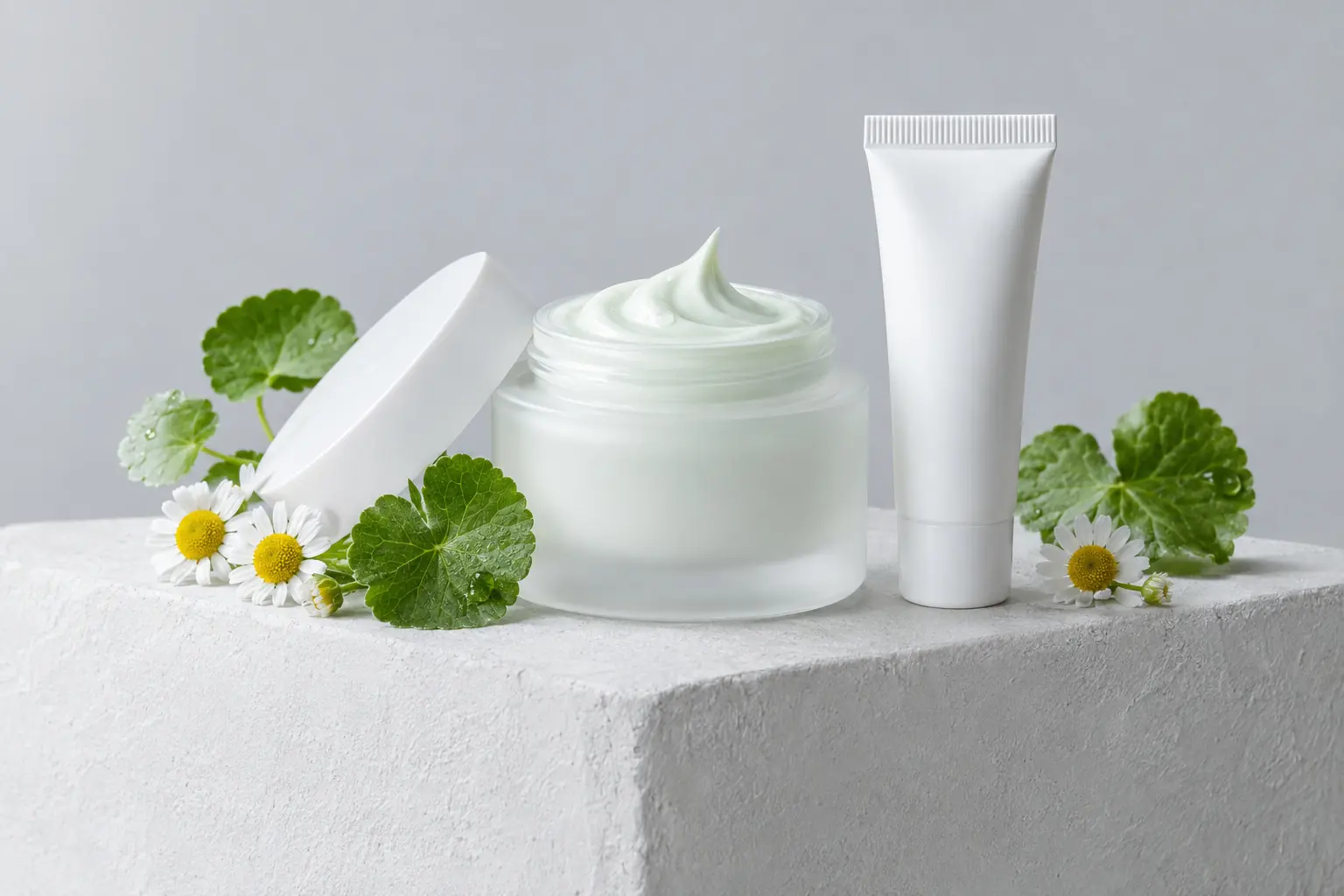
The brand defines the target complaint - redness, reactivity, sensitivity - and label wording that stays within a cosmetic, not biocidal, purpose; AKTO adapts the calming formula or develops a new one, monitors emulsion stability, and prepares the technical documentation for the chosen market. The finished formula is filled into a tube or jar, with the exact format agreed separately during the technical brief. See also: Targeted Face Care, Pigment Control Cream, Post-Procedure Calming Cream and Skin Recovery Balm.
Frequently Asked Questions
What formula does AKTO build a redness-relief cream on?
Why should a redness-relief cream avoid the word 'antiseptic' on its label?
What is AKTO's emulsion production capacity?
How is emulsion stability controlled during production?
Expert review
Reviewed by
 Illia Mariutsa
Researcher, organic chemistry
Google Scholar Anastasiia Bespalova
Paediatric orthopaedic and trauma surgeon
ORCID
Standards we work to
 ISO 22716 (GMP)
 ISO 22000 (HACCP)
 Regulation (EC) No 1223/2009
 Directive 2002/46/EC
 Halal
Why AKTO
- Calming base formula with D-Panthenol 6% and calendula
- Humidity and temperature checked twice per shift
- Emulsion capacity up to 30 t in Kyiv (Ukraine), 10 t in Warsaw (Poland)
- Phenoxyethanol preservative for the emulsion, up to 1.0%
- MOQ from 50 kg, ISO 22716 (GMP)