
Blog
What Is Contract Manufacturing and How to Choose a Cosmetics or Supplement Manufacturer
How contract manufacturing of cosmetics and supplements works, who it suits and how to vet a manufacturer before signing the agreement.
- Contract manufacturing
- Choosing a manufacturer
In brief
Contract manufacturing is a model in which a brand orders a product from a company with its own production capacity, while the brand itself handles positioning and sales. The article explains who does what, the path from brief to shipment, how contract manufacturing differs from private label and white label, its benefits and limits, and a checklist of questions to ask a manufacturer before signing.
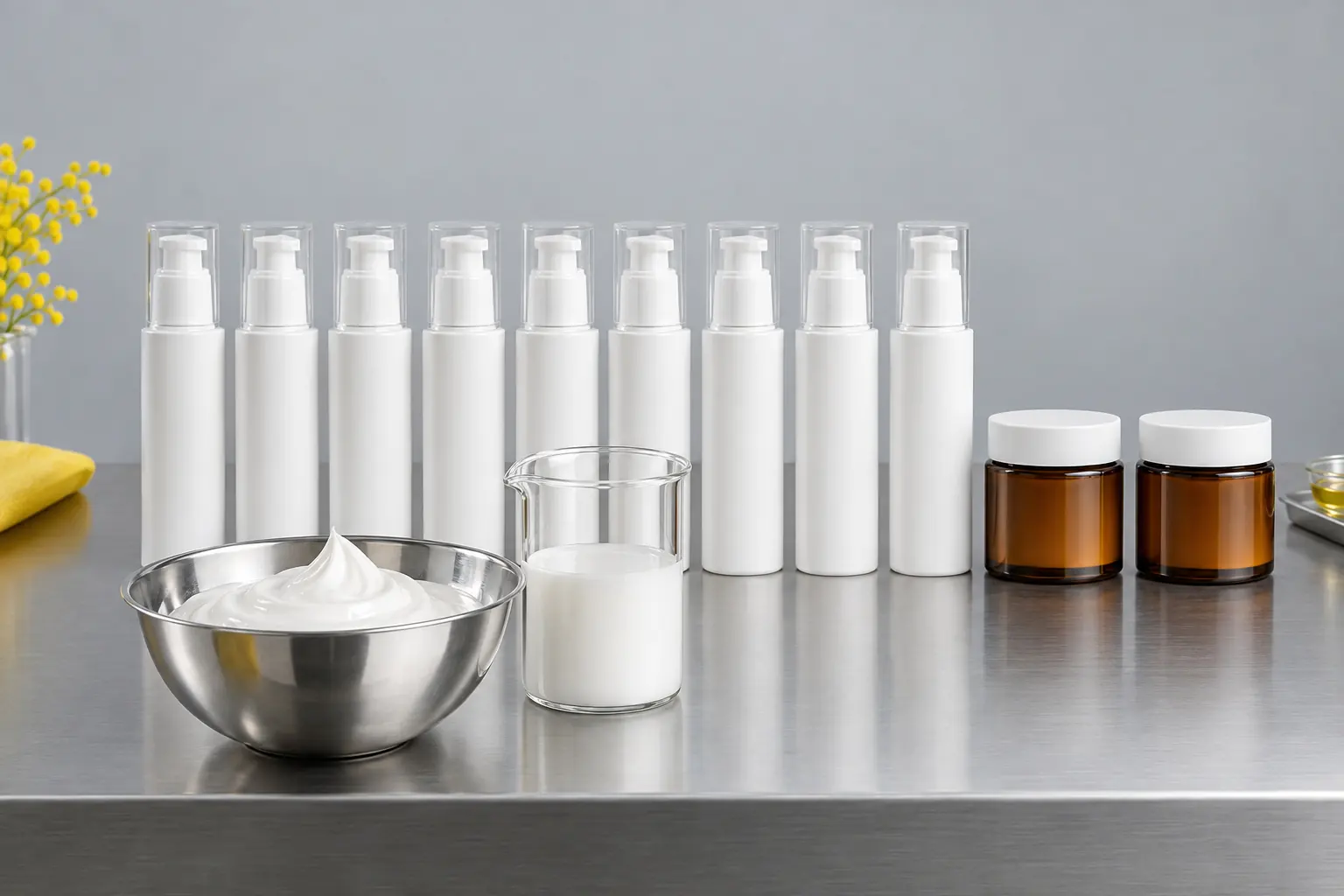
Contract manufacturing is a model in which a brand orders a product from a company with its own production capacity, while the brand itself is responsible for positioning and sales. Startups with a first cream and pharmacy chains with dozens of items under their own label both work this way. We explain what cooperation looks like in practice, who it suits, and how to vet a cosmetics or dietary supplement manufacturer before signing a contract.
01
Who does what in the model
Take an example. A salon owner wants a home-care cream under the salon's name. She comes with an idea and a target price, the manufacturer develops the formula, purchases raw materials, produces and fills the product, and the salon receives finished jars with its own label.
| Brand (the customer) | Contract manufacturer |
|---|---|
| Product concept, target audience, shelf price | Development or adaptation of the formulation |
| Name, trademark, design | Purchasing raw materials and incoming inspection |
| Marketing and sales channels | Production, filling, quality control |
| Responsible Person role towards the regulator (most often) | GMP documents, technological data for the product file |
The boundary between the areas of responsibility is flexible. At AKTO the client can hand us the full cycle: from raw material selection and formulation development to label design, GTIN-13 barcode registration, regulatory documents and shipment. How this is organized at AKTO is described on the page about contract manufacturing services.
02
What cooperation looks like: from brief to shipment
- Brief. The customer describes the product, audience, desired volume and target price.
- Estimate and commercial offer. The technologist assesses how realistic the formula is, and the manager calculates the cost and the minimum batch.
- Contract and NDA. These fix the rights to the formulation, the specification, the deadlines and the acceptance procedure.
- Formulation development. The laboratory prepares samples, the customer tests them and approves the final version.
- Stability and packaging compatibility tests. The formula is checked in the same packaging in which it will be sold. How this is done is described on the page about quality control and testing.
- Packaging and label. Selecting packaging, developing and approving the artwork.
- Documents. For cosmetics: the product file, the safety report, notification; for supplements: a notification to the State Service of Ukraine on Food Safety and Consumer Protection of the intention to place the product on the market for the first time.
- Production. Purchasing and incoming inspection of raw materials, manufacture, filling, control of the finished product.
- Shipment. To the client's warehouse, a marketplace fulfillment center or a wholesale partner.
This is a typical scheme. How the process is built specifically at AKTO (10 steps, up to seven sample iterations) is described on the page How we work.
03
Contract manufacturing, private label and white label
These terms are often used as synonyms, although they mean different things. Contract manufacturing is the general model in which one company makes a product for another. Private label is a product that the manufacturer makes exclusively for one customer and that is sold only under its brand; most often the formulation for it is developed or adapted for that brand. White label is an identical ready-made product of the manufacturer that different brands sell under their own labels.
So manufacturing under your own brand is possible in both variants; the difference lies in the uniqueness of the formula, the timelines and the rights to it. We compare the two models in more detail in a separate article on private label and white label.
04
Benefits and limits for the brand
What the brand gets by working with a contract manufacturer:
- a launch with no investment in premises, equipment and a laboratory;
- access to technologists who have already worked with similar products;
- production under GMP and a quality control system without an in-house department;
- the ability to start with a small batch and increase volumes as sales grow;
- the team's time goes to product, marketing and sales.
What to bear in mind:
- the production schedule is agreed against the contractor's workload, so orders are best planned in advance;
- process control happens through the contract, the specification and audit, not directly;
- without clear terms on the formulation, the brand depends on a single manufacturer.
05
Who benefits from this model
Startups and new brands
There is no need to invest in a workshop, equipment and a quality system. The minimum batch lets you test demand without large stock: at AKTO it is from 50 kg for cosmetics and from 10 kg of raw material or 20,000 capsules for dietary supplements.
Brands that are scaling
You can add a new category without building a separate line. For example, a skincare brand launches collagen supplements or offloads its own production in the peak sales season.
Pharmacy and retail chains
A private label gives control over the assortment and price and sets the chain apart from competitors whose shelves carry the same brands. The manufacturer ensures consistent quality from batch to batch.
06
How to choose a contract manufacturer: a checklist
| What to check | How to check | Warning sign |
|---|---|---|
| Quality system certificates | For cosmetics: ISO 22716 (GMP); for supplements: ISO 22000. Ask for copies, check the validity period, the certification body and the scope | The certificate has expired or does not cover your category |
| In-house laboratory | Whether R&D and quality control are on site, and which analyses they run themselves | Development "at partners", all analyses outsourced |
| Minimum batch | Whether it matches your sales plan | The minimum volume forces you to order a year's stock in advance |
| Documents | Who prepares the specifications, the file and the safety report, and files the notification (cosmetics) or notice (supplements) | The documents are entirely shifted onto the customer |
| Experience in your category | Examples of products in the same format | Not a single similar product |
| Production audit | A visit to the production site: areas, warehouses, laboratory | Refusal to show the production site |
For comparison: AKTO's production site operates under ISO 22716 (GMP) for cosmetics and ISO 22000 (HACCP) for dietary supplements, and the quality management system is also certified to ISO 9001. The in-house R&D laboratory develops formulas and controls quality. Details by area are on the pages cosmetics contract manufacturing and dietary supplement contract manufacturing.
07
Questions to ask the manufacturer before signing the contract
It is better to get the answers in writing and carry them into the contract:
- Who will own the formulation, and can you transfer it to another manufacturer?
- Does the manufacturer produce its own retail brands that may compete with yours?
- What is included in the price: raw materials, packaging, filling, labeling, documents?
- What development and production lead times are fixed in the contract?
- How is a batch accepted, and what happens if it does not meet the specification?
- How long does the manufacturer keep control samples of each batch?
- Who purchases packaging and labels, and who is responsible for packaging defects?
- What documents will you receive with each batch?
How to fix these answers in the contract is covered in the article on the contract manufacturing agreement.
If you are choosing a contractor for your product, write to an AKTO manager: we will explain how cooperation is organized and prepare a calculation for your volume. The terms and working format are on the page about contract manufacturing.
Frequently Asked Questions
How much does contract manufacturing cost?
Can you order cosmetics and dietary supplements from one manufacturer?
Who is responsible for the quality of the finished product?
Can you change the manufacturer when the brand grows?
Standards we work to
 ISO 22716 (GMP)
 ISO 22000 (HACCP)
 Regulation (EC) No 1223/2009
 Directive 2002/46/EC
 Halal
Why AKTO
- Production under ISO 22716 (GMP) and ISO 22000 (HACCP)
- Two sites, Kyiv (Ukraine) and Warsaw (Poland), for flexible supply
- In-house R&D lab behind every new product
- MOQ from 50 kg cosmetics or 10 kg / 20,000 capsules supplements
- Commissioned formula stays exclusive to the brand