
Private Label
Body Scrub
A rinse-off product for mechanical skin exfoliation - by sugar, salt or a cream base, depending on the format a brand chooses.
- ISO 22716 (GMP)
In brief
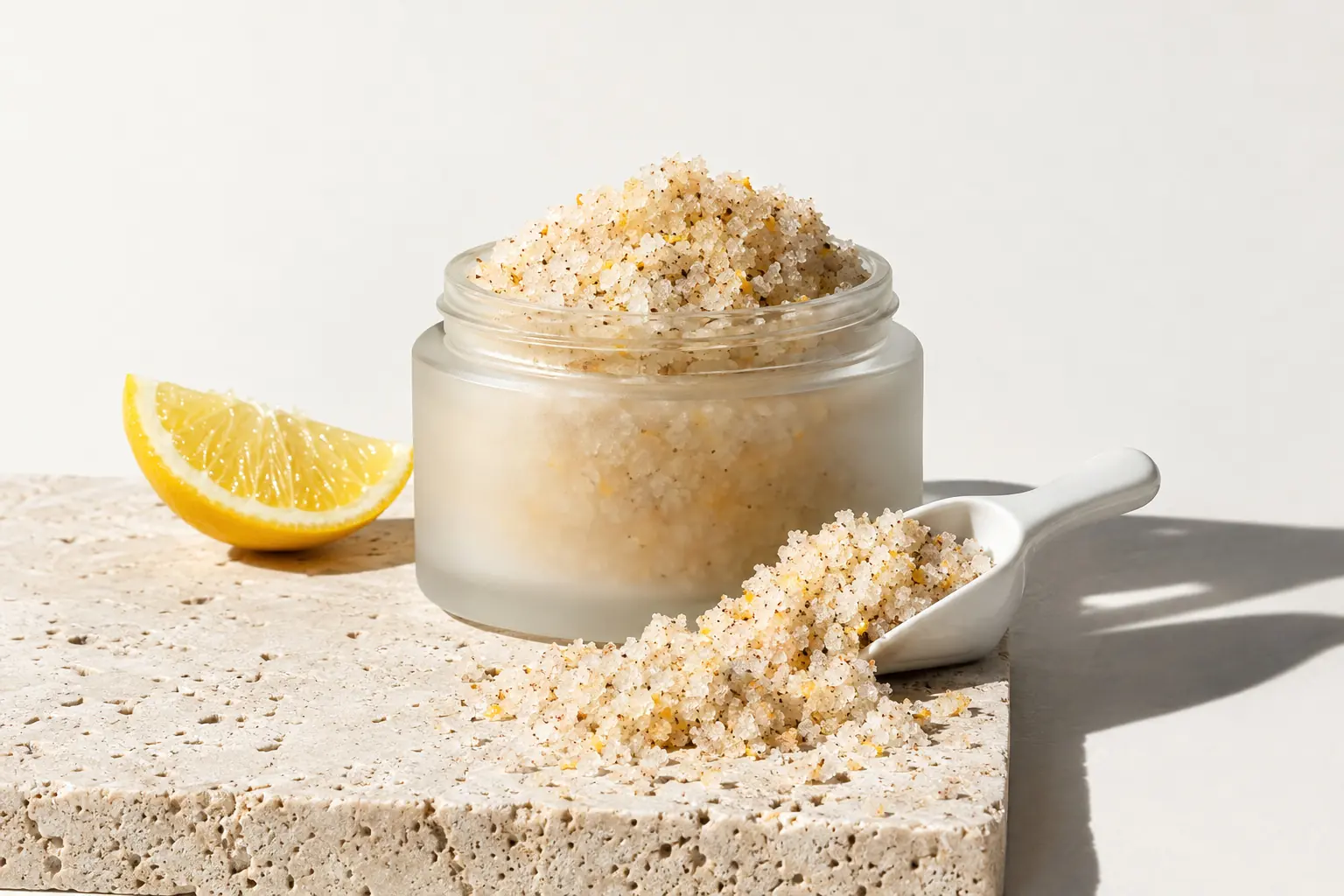
A body scrub is a rinse-off cosmetic that exfoliates the skin mechanically, using abrasive particles. AKTO already manufactures a sugar-based body scrub with a mango and passion-fruit profile in a 250 g jar, and develops salt and cream scrubs to order on the same production in Kyiv (Ukraine) and Warsaw (Poland). The abrasive and the label claim both have to match EU microplastic rules and truthfulness requirements.
01
What a body scrub is
Article 2(1)(a) of Regulation (EC) No 1223/2009 covers mechanical exfoliation as a way of 'keeping in good condition' or 'changing the appearance of' the skin - which is why a scrub stays a cosmetic as long as it claims cleansing and surface renewal rather than treating a skin disorder. Unlike a chemical peel, which works through acids, a scrub relies entirely on a physical abrasive - sugar, salt or mineral particles suspended in a cream base - and the abrasive chosen decides the further regulatory questions and the texture of the finished product.
02
Abrasive choice and the microplastic restriction
Regulation (EC) No 1272/2008 (CLP), Article 1(5)(c), excludes a finished cosmetic product defined under Regulation 1223/2009 from CLP's hazard-classification and labelling rules, and that applies to a body scrub the same way it applies to any other cosmetic. The intentionally-added microplastic restriction in Regulation (EU) 2023/2055 (REACH Annex XVII, entry 78) targets solid, synthetic-polymer particles; a natural, water-soluble or biodegradable abrasive such as sugar or salt falls outside that restriction's scope, unlike the synthetic polyethylene microbeads historically used in some scrub formulas. A 'natural' or 'gentle' claim about the abrasive must match the actual particle used in the formula, under the Truthfulness and Evidential Support criteria of Regulation (EU) No 655/2013.
03
Regulatory position in the EU, UK and Ukraine
The CLP exclusion and the microplastic restriction apply in the same way across the EU and the UK, which runs its own domestic version of these rules. In Ukraine, AKTO manufactures a body scrub under its own technical specification, TU U 20.4-43961492-001:2020, and under Cabinet of Ministers Resolution No. 65 for cosmetic products on the Ukrainian market.
04
What AKTO offers
AKTO already manufactures a sugar-based body scrub with a mango and passion-fruit profile in a 250 g jar. Alongside it, AKTO manufactures enzyme, mineral and bentonite exfoliating powders for professional use, which address a different concern - before- and after-hair-removal skin care rather than general body exfoliation. AKTO develops and manufactures a salt or cream body scrub to order, asking for a reference sample of at least 50 g with the desired abrasive and texture. Minimum order for the cosmetics line starts from 50 kg, manufactured at plants in Kyiv (Ukraine) and Warsaw (Poland), certified to ISO 22716 (GMP), ISO 9001, ISO 22000 (HACCP).
05
Choosing a scrub format
- The brand chooses the abrasive - sugar (the format AKTO already manufactures), salt or a cream base.
- The brand drafts the intended claim ('natural', 'gentle') to match the actual formula.
- AKTO checks the abrasive against the REACH 2023/2055 microplastic restriction and prepares labelling.
- The brand approves a 50 g sample, and series production starts from 50 kg.
06
See also
See also: Exfoliation (Body), Sugar Body Scrub, Salt Body Scrub, Cream Body Scrub and Body Peel.
Frequently Asked Questions
How is a body scrub different from a body peel?
Does a scrub's abrasive fall under the microplastic ban?
What body scrub format does AKTO already manufacture?
What sample does AKTO need for a new scrub?
Expert review
Reviewed by
 Illia Mariutsa
Researcher, organic chemistry
Google Scholar Anastasiia Bespalova
Paediatric orthopaedic and trauma surgeon
ORCID
Standards we work to
 ISO 22716 (GMP)
 ISO 22000 (HACCP)
 Regulation (EC) No 1223/2009
 Directive 2002/46/EC
 Halal
Why AKTO
- AKTO already manufactures a sugar-based body scrub in a 250 g jar
- Salt and cream scrubs are developed to order on the same production
- Natural abrasives (sugar, salt) fall outside the REACH 2023/2055 microplastic restriction
- Production from 50 kg, plants in Kyiv (Ukraine) and Warsaw (Poland), ISO 22716 (GMP)