
Private Label
Cream Body Scrub
An emulsion base instead of a gel or oil - a richer scrub texture with an abrasive, made on a dedicated production line.
- ISO 22716 (GMP)
In brief
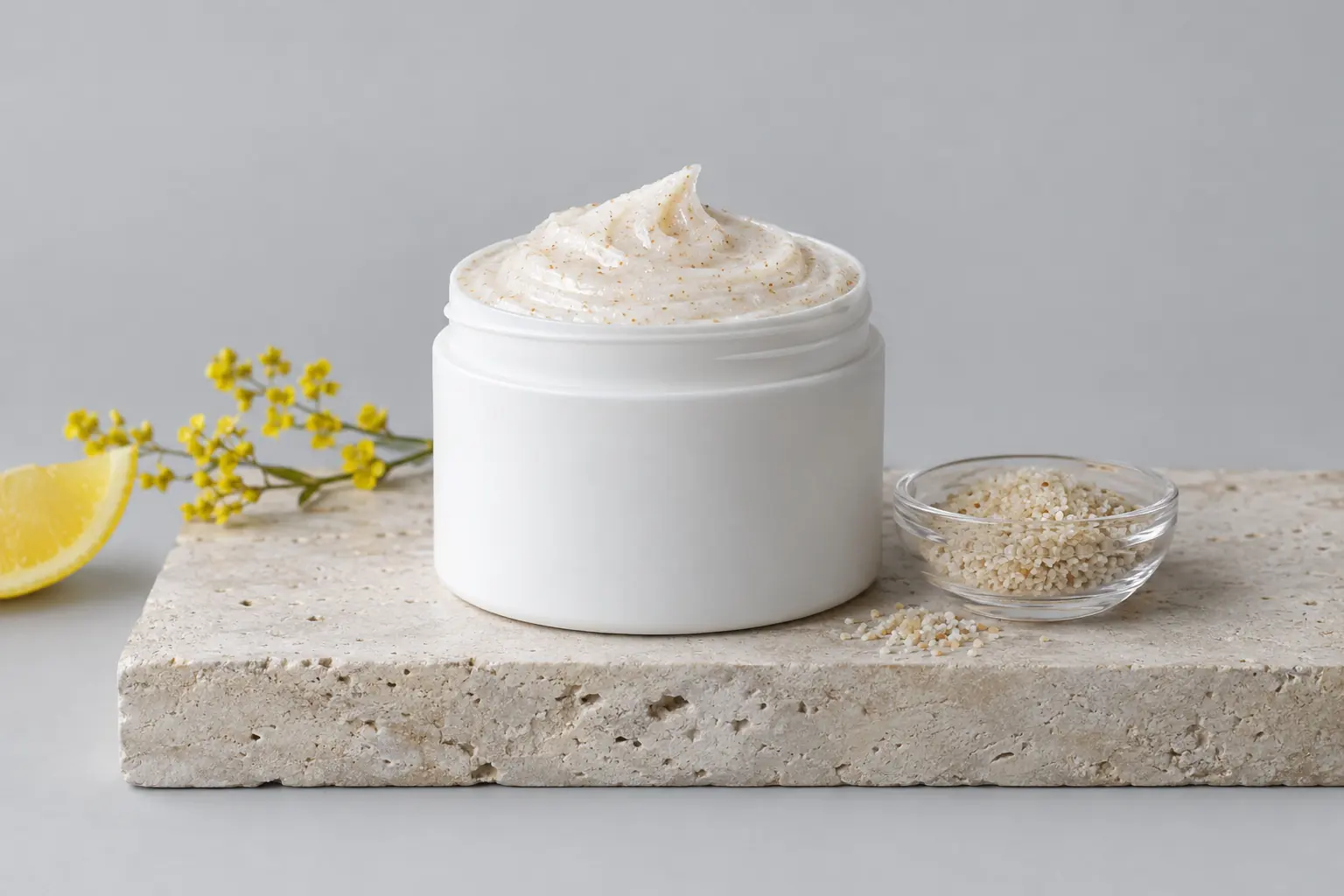
A cream body scrub is a water-containing emulsion carrying an abrasive, richer in texture than a gel-based sugar scrub. AKTO develops and manufactures a cream scrub to order on a dedicated emulsion line with capacity of up to 30 tonnes per month in Kyiv (Ukraine) and up to 10 tonnes per month in Warsaw (Poland) - separate from the gel line that runs its sugar scrub.
01
What a cream body scrub is
A cream body scrub is a water-containing emulsion carrying an abrasive; compared with a gel-based sugar scrub, it has a richer, more 'skincare' texture and is often positioned as a 2-in-1: cleansing and moisturising in one application. That texture difference does not change the product's function, but it does change the durability and labelling requirements.
02
Durability and labelling
Unlike an anhydrous solid scrub, a cream scrub is a water-containing emulsion, so Article 19(1)(c) of Regulation (EC) No 1223/2009 expects it to carry either a minimum-durability date or, where shelf life exceeds 30 months, a period-after-opening (PAO) symbol - the exemption available to an anhydrous solid format is unlikely to apply here. The abrasive in a cream scrub, as in any scrub, falls under the REACH 2023/2055 restriction (Annex XVII, entry 78) only if it is a synthetic polymer particle - the texture itself (cream, gel or oil) does not decide that; the choice of abrasive does. As a rinse-off product, a cream scrub falls under the 0.01% by-weight allergen labelling threshold of Annex III.
03
Regulatory position in the EU, UK and Ukraine
The durability and allergen-labelling requirements apply the same way across the EU and the UK. In Ukraine, AKTO manufactures the cream scrub under its own technical specification, TU U 20.4-43961492-001:2020, and under Cabinet of Ministers Resolution No. 65.
04
What AKTO offers
For a cream scrub, AKTO uses a dedicated emulsion line with capacity of up to 30 tonnes per month in Kyiv (Ukraine) and up to 10 tonnes per month in Warsaw (Poland) - that line, rather than the gel line behind its sugar scrub. AKTO develops and manufactures a cream scrub to order, asking for a reference sample of at least 50 g. Standard packaging is a jar from 50 to 250 g, minimum order for the cosmetics line starts from 50 kg, manufactured at plants in Kyiv (Ukraine) and Warsaw (Poland), certified to ISO 22716 (GMP), ISO 9001, ISO 22000 (HACCP).
05
Getting started
- The brand supplies a reference sample of at least 50 g with the desired abrasive and cream texture.
- AKTO checks the abrasive against REACH 2023/2055 regardless of the base texture.
- AKTO sets a minimum-durability date or a PAO symbol under Article 19(1)(c).
- The brand approves a sample, and series production starts from 50 kg in a 50-250 g jar.
06
See also
See also: Exfoliation (Body), Body Scrub, Sugar Body Scrub and Salt Body Scrub.
Frequently Asked Questions
How is a cream scrub different from a gel-based sugar scrub?
Is microplastic banned in a cream scrub?
What line does AKTO use to manufacture a cream scrub?
What is the minimum order for a cream scrub?
Expert review
Reviewed by
 Illia Mariutsa
Researcher, organic chemistry
Google Scholar Anastasiia Bespalova
Paediatric orthopaedic and trauma surgeon
ORCID
Standards we work to
 ISO 22716 (GMP)
 ISO 22000 (HACCP)
 Regulation (EC) No 1223/2009
 Directive 2002/46/EC
 Halal
Why AKTO
- Cream scrub is made on a dedicated emulsion line up to 30 t/month in Kyiv (Ukraine)
- A water-containing emulsion needs a durability date or PAO symbol under Article 19(1)(c)
- REACH 2023/2055 applicability depends on the abrasive, not the base texture
- Production from 50 kg in a 50-250 g jar, plants in Kyiv (Ukraine) and Warsaw (Poland)