
Private Label
Salt Body Scrub
A mineral abrasive instead of sugar - the same gel format, with a different sensory profile and shelf positioning.
- ISO 22716 (GMP)
In brief
A salt body scrub is a gel base in which sea salt or table salt replaces sugar as the abrasive. AKTO develops and manufactures a salt scrub to order on the same production line that already runs its sugar scrub, from a reference sample of at least 50 g. Salt stays a natural abrasive outside the microplastic restriction.
01
What a salt body scrub is
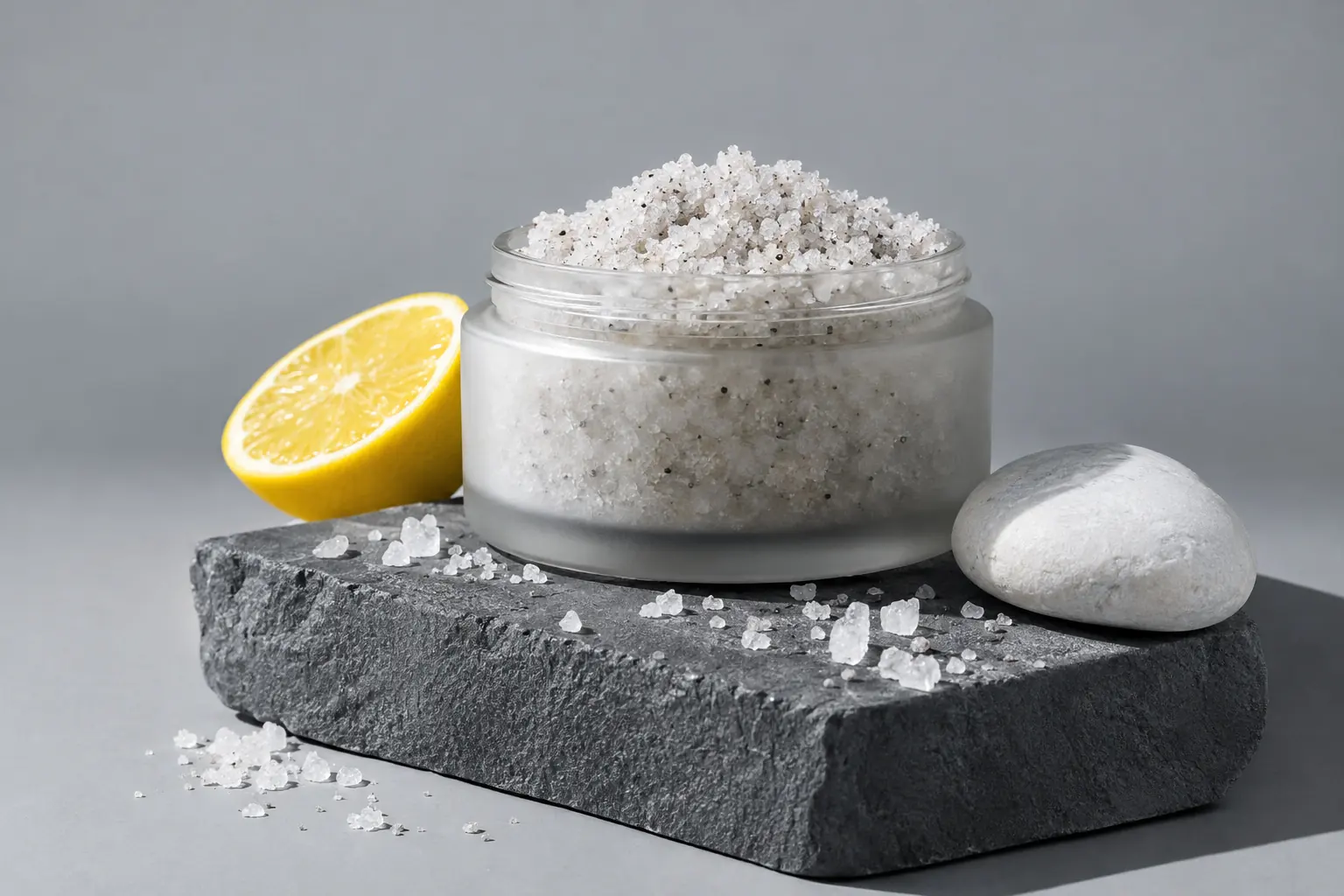
A salt body scrub is a gel or oil base in which sea salt (INCI Maris Sal) or table salt (Sodium Chloride) crystals act as the mechanical abrasive. A brand chooses salt over sugar for a coarser, more pronounced abrasive texture and a different shelf story - a 'mineral' or 'spa' scrub - though the regulatory status of the product stays the same as its sugar counterpart.
02
The abrasive and label claims
Sea salt or table salt, the typical abrasive in a salt scrub, is a natural, water-soluble mineral particle that falls outside the synthetic-polymer scope of the intentionally-added-microplastic restriction in Regulation (EU) 2023/2055 (REACH Annex XVII, entry 78) - the same exemption that applies to sugar. As a rinse-off product, a salt scrub falls under the 0.01% by-weight fragrance-allergen labelling threshold of Annex III to Regulation 1223/2009. A claim that a salt scrub exfoliates 'more intensively' than a sugar scrub needs evidence proportionate to that comparative claim, under the Evidential Support criterion of Regulation (EU) No 655/2013 - abrasive intensity cannot simply be asserted without testing.
03
Regulatory position in the EU, UK and Ukraine
The microplastic exemption and the allergen threshold apply the same way across the EU and the UK. In Ukraine, AKTO manufactures the salt scrub under its own technical specification, TU U 20.4-43961492-001:2020, and under Cabinet of Ministers Resolution No. 65.
04
What AKTO offers
AKTO's mechanical-exfoliation format is a sugar-based scrub gel produced on its Body-category liquid-systems line. AKTO develops and manufactures a salt-based scrub to order on that same gel-base equipment, asking for a reference sample of at least 50 g with the desired abrasive in place of the sugar base. Standard jar packaging for a body-care product runs from 50 to 250 g, minimum order for the cosmetics line starts from 50 kg, manufactured at plants in Kyiv (Ukraine) and Warsaw (Poland), certified to ISO 22716 (GMP), ISO 9001, ISO 22000 (HACCP).
05
Getting started
- The brand supplies a reference sample of at least 50 g with the desired salt-crystal size and fragrance.
- AKTO adapts the gel base of its sugar scrub to the salt abrasive.
- Comparative-intensity claims are backed with evidence under Regulation (EU) No 655/2013.
- The brand approves a sample, and series production starts from 50 kg in a 50-250 g jar.
06
See also
See also: Exfoliation (Body), Body Scrub, Sugar Body Scrub and Cream Body Scrub.
Frequently Asked Questions
Does salt in a scrub fall under the microplastic restriction?
Can a salt scrub be marketed as 'more intensive' than a sugar scrub?
What line does AKTO use to develop a salt scrub?
What sample does AKTO need to brief a salt scrub?
Expert review
Reviewed by
 Illia Mariutsa
Researcher, organic chemistry
Google Scholar Anastasiia Bespalova
Paediatric orthopaedic and trauma surgeon
ORCID
Standards we work to
 ISO 22716 (GMP)
 ISO 22000 (HACCP)
 Regulation (EC) No 1223/2009
 Directive 2002/46/EC
 Halal
Why AKTO
- A salt scrub is developed on the line that already runs AKTO's sugar scrub
- Sea/table salt is a natural abrasive outside the REACH 2023/2055 microplastic restriction
- Comparative-intensity claims are backed with evidence under Reg. 655/2013
- Production from 50 kg in a 50-250 g jar, plants in Kyiv (Ukraine) and Warsaw (Poland)