
Private Label
Face Clay Mask
AKTO develops and manufactures face clay masks to order on its dry/powder mask line, alongside its already-produced cream mask.
- ISO 22716 GMP
In brief
Company AKTO LLC (AKTO) develops and manufactures face clay masks to order on its dry/powder mask line - a declared production format alongside its already-produced cream mask with panthenol and calendula. Mineral-clay purity and trace heavy-metal content are recorded in the product's technical file per Annex I Part A of the EU regulation.
01
What a clay mask is and who it suits
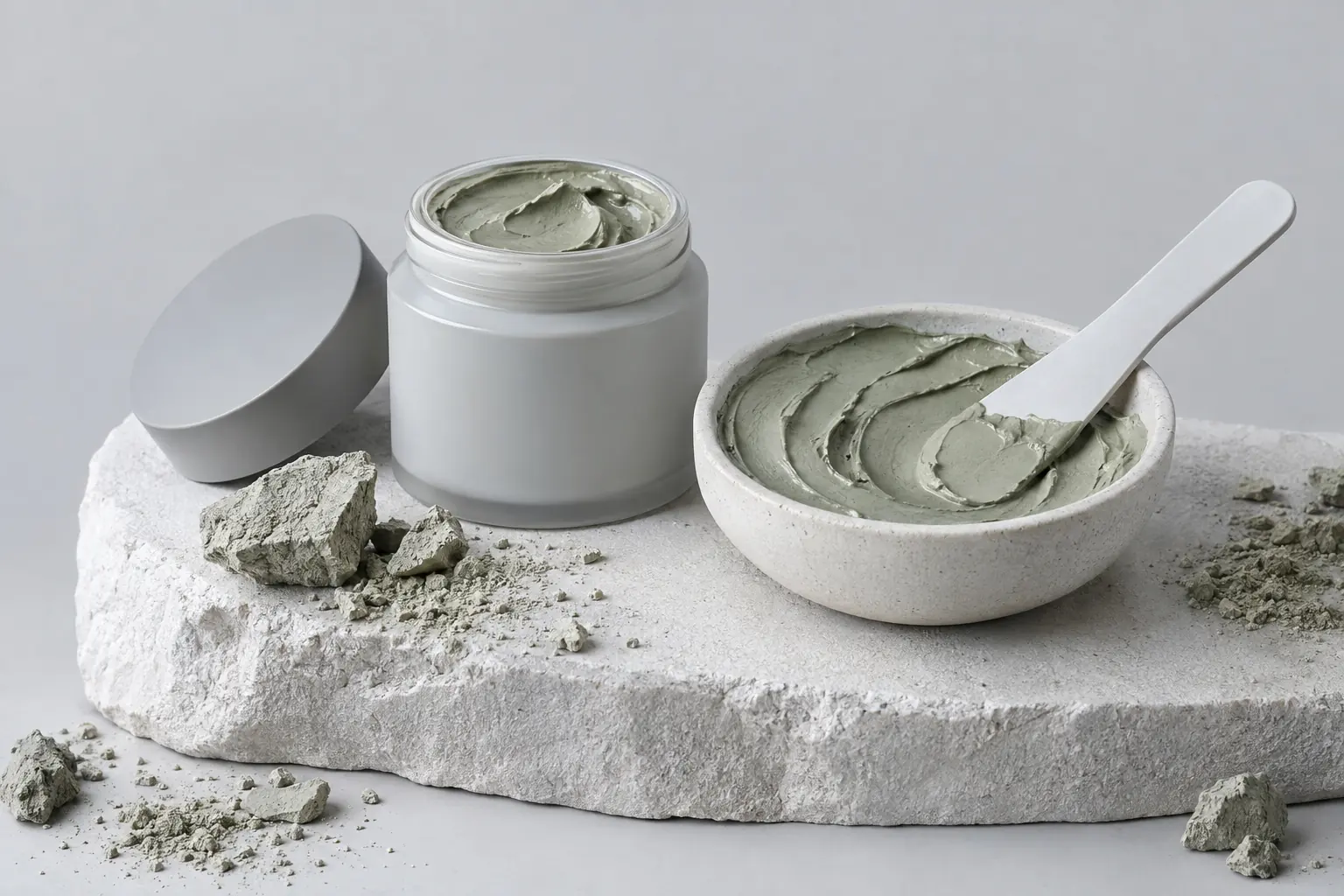
A clay mask works on mineral raw material - kaolin or bentonite - that absorbs excess skin oil and gives a visible mattifying effect as it dries on the face. Brands position this format for oily and blemish-prone skin, used on a course of once or twice a week rather than daily, often as a separate product for customers who find a cream mask too rich. Within a mask range, the clay format covers cleansing and oil control alongside nourishing and gel textures.
02
The format AKTO develops to order
AKTO develops and manufactures face clay masks to order on its dry/powder mask line - a declared production format alongside its already-produced cream mask with panthenol, calendula extract, black cumin oil, niacinamide and arginine. The clay type, the consistency (a powder to mix or a ready paste) and the packaging format are agreed individually during recipe development for the brand.
03
Mineral purity under EU regulation
Article 17 of Regulation (EC) No 1223/2009 allows a small, unintended presence of an Annex II-prohibited substance stemming from impurities in natural ingredients, the manufacturing process, storage or packaging migration, where technically unavoidable under good manufacturing practice and consistent with the Article 3 safety requirement - the basis for tolerating trace heavy-metal impurities that occur naturally in mined clays such as kaolin or bentonite. Annex I Part A Section 4 requires the safety report to document the purity of the substances used and, for traces of prohibited substances, evidence of their technical unavoidability. Annex II prohibits lead (entry 289), mercury (entry 221), arsenic (entry 43) and cadmium (entry 68) - the specific metals a raw-material purity file must account for.
04
AKTO's production capability
The minimum batch is 50 kg of finished formulation at AKTO's facilities in Kyiv (Ukraine) and Warsaw (Poland). The testing package for masks mandatorily includes microbiology and preservative-challenge testing - critical for a clay mask's rinse-off phase. Production is certified to ISO 9001:2015, ISO 22000:2018 (HACCP; combined certificate No. 44600111204) and ISO 22716 (GMP).
05
Getting started
A brand sets the clay type, consistency and target effect - cleansing, mattifying or detox; AKTO develops the recipe to order, runs microbiology and preservative-challenge testing, and prepares the technical documentation for the chosen market. Masks often become a range's flagship product for marketing visuals thanks to their visibly demonstrable application effect. See also: Masks (Face), Face Mask Creamy and Face Mask Gel.
Frequently Asked Questions
Does AKTO manufacture clay masks for the face?
How does EU regulation treat mineral-clay purity in cosmetics?
Which heavy metals does Annex II control for clay masks?
What testing is mandatory for a clay mask in AKTO's package?
Expert review
Reviewed by
 Illia Mariutsa
Researcher, organic chemistry
Google Scholar Anastasiia Bespalova
Paediatric orthopaedic and trauma surgeon
ORCID
Standards we work to
 ISO 22716 (GMP)
 ISO 22000 (HACCP)
 Regulation (EC) No 1223/2009
 Directive 2002/46/EC
 Halal
Why AKTO
- Clay mask developed on the dry/powder mask line
- Same raw-material purity standard as the cream mask
- Heavy-metal control per Annex II of the EU regulation
- Mandatory microbiology and preservative-challenge testing
- MOQ from 50 kg, facilities in Kyiv (Ukraine) and Warsaw (Poland)