
Private Label
Face Mask Textured
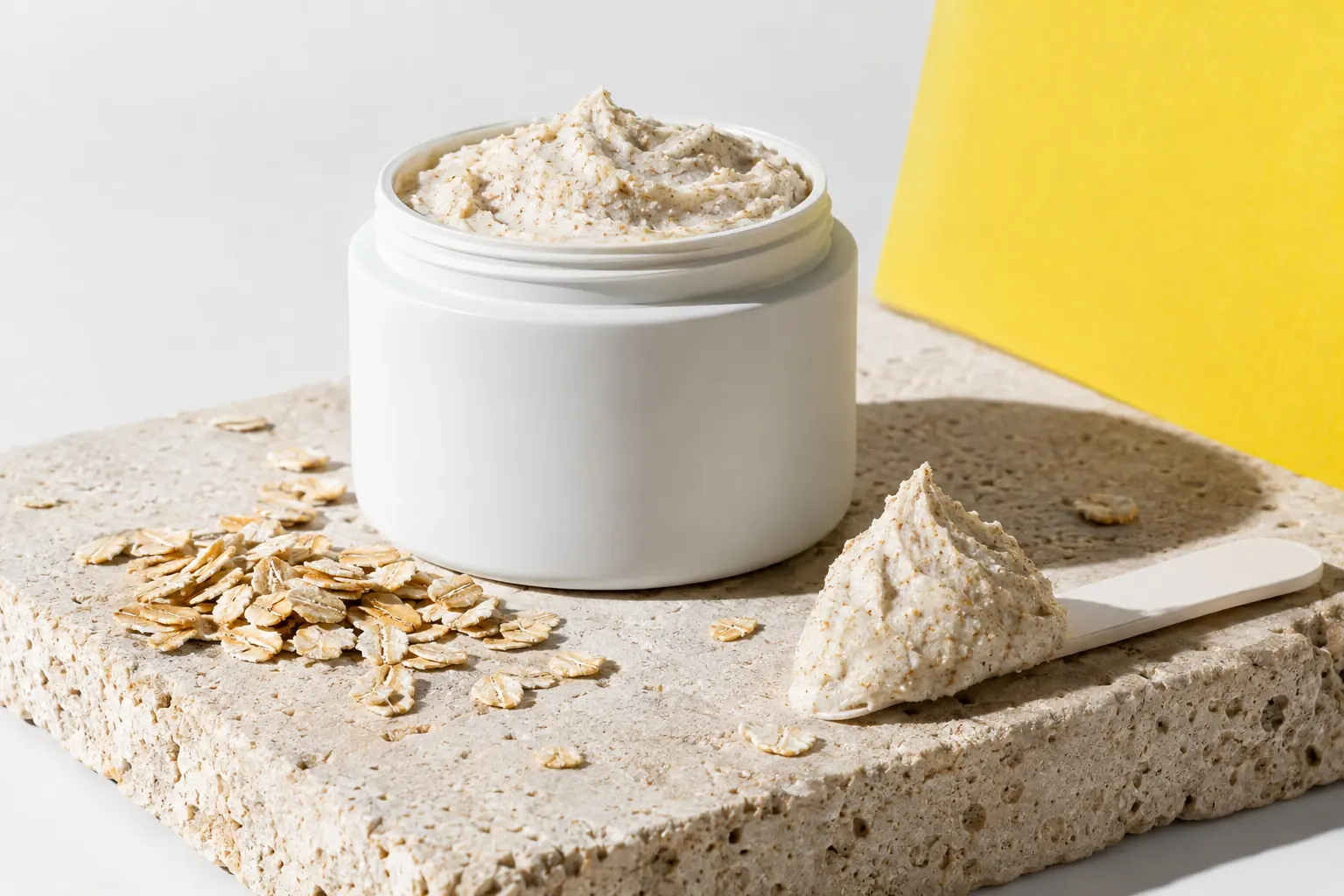
AKTO develops and manufactures textured face masks to order, combining a cream base with a granular element drawn from its sugar-scrub experience.
- ISO 22716 GMP
In brief
Company AKTO LLC (AKTO) develops and manufactures textured face masks to order, combining its already-produced cream-mask base (D-panthenol 6%, 100 ml pump bottle) with a granular element drawn from its sugar-scrub production (250 g jar). Particle-dispersion stability is confirmed through physicochemical testing under Annex I Part A.
01
What a textured mask is
A textured mask combines a cream or gel base with a granular or rich element within the formula - a fine abrasive, a gel-like bead or a denser consistency that adds a noticeable tactile effect on application and rinse-off. Brands launch this format as a premium variant of a basic mask, with a visible 'wow effect' for social media and marketing video. Within a mask range, a textured format sits between a classic cream mask and a scrub in terms of tactile intensity. For a customer, it reads as a premium ritual, which can justify a higher price point within the range.
02
The format AKTO develops to order
AKTO develops and manufactures textured face masks to order, combining the base of its already-produced cream mask - D-panthenol (6%), in a 100 ml pump bottle - with a granular element drawn from its sugar-scrub production, packaged in a 250 g jar. Whether the texturising component is natural or synthetic is agreed separately, since that choice determines which regulation applies to the finished formula.
03
Stability and regulatory requirements
Annex I Part A Section 2 of Regulation (EC) No 1223/2009 requires the safety report to cover the physicochemical characteristics of the substances, the mixture and the product itself, including stability under foreseeable storage conditions - exactly what confirms particle-dispersion stability in a textured cream base. If a textured mask's granular element turns out to be a synthetic microparticle rather than a natural texturiser, it would fall under the same rinse-off restriction as an abrasive scrub under Regulation (EU) 2023/2055 (REACH Annex XVII entry 78); Articles 3 and 10 on general safety apply to the mask regardless of its texture.
04
AKTO's production capability
The minimum batch is 50 kg of finished formulation at AKTO's facilities in Kyiv (Ukraine) and Warsaw (Poland). The testing package includes physicochemical analysis and stability testing, applied specifically to verify particle-dispersion stability in a textured formula. Both facilities, in Kyiv (Ukraine) and Warsaw (Poland), let a brand pick a production site to match its market. Production is certified to ISO 9001:2015, ISO 22000:2018 (HACCP; combined certificate No. 44600111204) and ISO 22716 (GMP).
05
Getting started
A brand sets the texturising component, its density and the target tactile effect; AKTO combines the cream base with the granular element to the brand's recipe, runs physicochemical stability testing and prepares the technical documentation for the chosen market. A mask with a visibly demonstrable application effect often becomes a range's flagship product for marketing materials. See also: Masks (Face), Face Scrub and Face Mask Gel.
Frequently Asked Questions
Does AKTO manufacture textured face masks?
What does Annex I Part A Section 2 check for a textured mask?
When does a textured mask fall under the microplastics restriction?
Which base mask does AKTO use as a reference for the textured format?
Expert review
Reviewed by
 Illia Mariutsa
Researcher, organic chemistry
Google Scholar Anastasiia Bespalova
Paediatric orthopaedic and trauma surgeon
ORCID
Standards we work to
 ISO 22716 (GMP)
 ISO 22000 (HACCP)
 Regulation (EC) No 1223/2009
 Directive 2002/46/EC
 Halal
Why AKTO
- Textured mask built on the D-panthenol cream-mask formula
- Granular element drawn from the sugar-scrub production line
- Physicochemical testing for particle-dispersion stability
- Microplastics restriction considered when choosing the texturiser
- MOQ from 50 kg, facilities in Kyiv (Ukraine) and Warsaw (Poland)