
Private Label
Fixing Powder
AKTO develops and manufactures fixing powder to a brand's order, combining its loose-powder filling experience with its own formula lines.
- ISO 22716 GMP
In brief
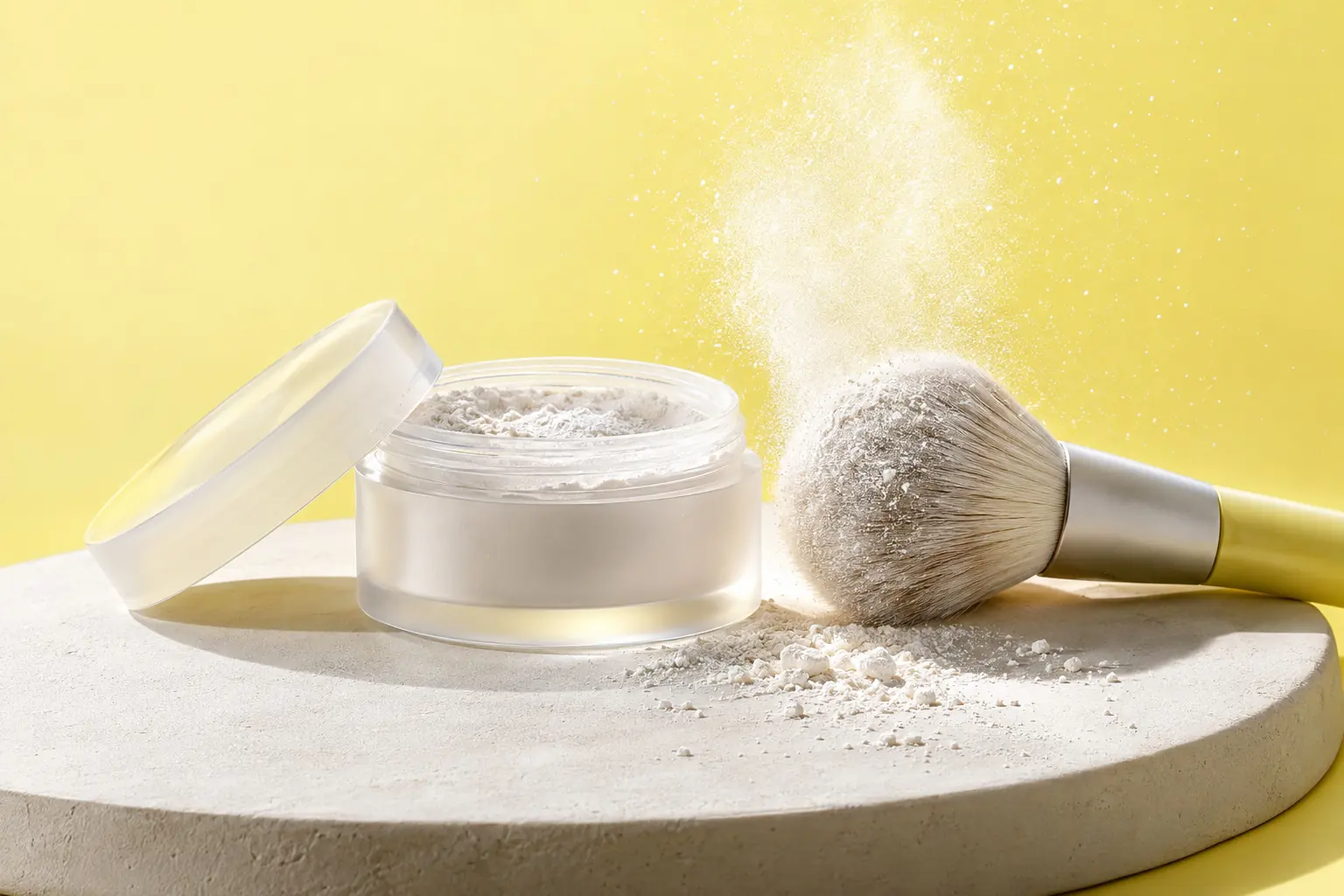
Fixing powder is a translucent, finely milled powder applied with a puff to set finished makeup without adding color. AKTO develops and manufactures fixing powder to a brand's order, pairing its own loose-powder filling experience with its general emulsion, cream and liquid lines. The base is talc under Annex III of Regulation (EC) No 1223/2009, with colorants checked against Annex IV.
01
What fixing powder is
Fixing powder is a translucent or near-translucent, finely milled powder applied with a large puff over finished makeup to "set" it for the whole day without shifting the skin's shade. Unlike a colored powder, the key requirement for a fixing powder is particle fineness itself: the finer the milling, the less visible the powder is under camera and natural light.
02
Talc and mattifying fillers
Annex III entry 59 of Regulation (EC) No 1223/2009 permits Talc with no specific concentration limit, other than the label warning required for powdery products aimed at children under 3 — finely milled talc is typically the base a fixing powder is built on. Where the formula includes pigments for light tinting, Titanium Dioxide (CI 77891) and Iron Oxides (CI 77491, CI 77492, CI 77499) are permitted under Annex IV subject to the purity criteria of Directive 95/45/EC; Annex III entry 321 additionally caps pigmentary titanium dioxide at 25% in face products in loose powder form when 1% or more of its particles have an aerodynamic diameter of 10 micrometres or less.
03
Nanomaterials and notification
If a fixing powder contains a nanomaterial — for example, a nano-grade mattifying filler for a blurred skin-texture finish — Article 19(1)(g) of the Regulation requires the word "(nano)" in the list of ingredients, and Article 16 requires notification to the European Commission at least six months before such a product is placed on the market. Article 10 requires a Cosmetic Product Safety Report before a fixing powder is placed on the EU market.
04
What AKTO offers
AKTO develops and manufactures fixing powder to a brand's order, combining its own experience filling loose powder into a dispenser with its general emulsion, cream and liquid lines. The minimum order for a new private-label line starts at 50 kg. Production runs under combined certificate No. 44600111204 (ISO 9001:2015 and ISO 22000:2018 (HACCP)) and ISO 22716 (GMP). AKTO logs a fixing powder's milling fineness separately from its finish transparency in the development protocol, so a brand signs off on both before dispenser filling starts.
05
Getting started
A brand submits a brief with the desired milling fineness, whether light tinting is wanted, and the puff or dispenser type; AKTO matches talc and colorants to the Annex III and IV lists, checks nanomaterials under Articles 16 and 19(1)(g), and prepares documentation for the chosen market. Every fixing-powder project starts by matching the milling fineness to the finish requested in the brief. See also: Makeup Base & Complexion, Loose Setting Powder, Pressed Powder and Mineral Powder.
Frequently Asked Questions
Does AKTO develop fixing powder for a private label?
What is the key formulation requirement for a fixing powder?
When is notification to the European Commission required under Article 16?
What is the minimum batch for a new private-label fixing powder?
Expert review
Reviewed by
 Illia Mariutsa
Researcher, organic chemistry
Google Scholar Anastasiia Bespalova
Paediatric orthopaedic and trauma surgeon
ORCID
Standards we work to
 ISO 22716 (GMP)
 ISO 22000 (HACCP)
 Regulation (EC) No 1223/2009
 Directive 2002/46/EC
 Halal
Why AKTO
- Order-based development of fixing powder
- Talc and colorants checked against Annex III and IV of Regulation (EC) No 1223/2009
- Nanomaterials checked under Article 16 and Article 19(1)(g)
- MOQ from 50 kg for a new line
- Certified to ISO 9001:2015, ISO 22000:2018 (HACCP) and ISO 22716