
Private Label
Mineral Powder
AKTO develops and manufactures mineral powder to a brand's order, drawing on its own experience filling loose mineral powders.
- ISO 22716 GMP
In brief
Mineral powder is a loose product built on talc or mica-based mineral fillers, often marketed without synthetic colorants in a decorative-makeup format. AKTO already fills a loose mineral powder built on kaolin, calamine and plant-extract fillers for body skin care into a jar of about 100 g, and develops decorative facial mineral powders to a brand's order on that same filling experience. Colorants are checked against Annex IV of Regulation (EC) No 1223/2009.
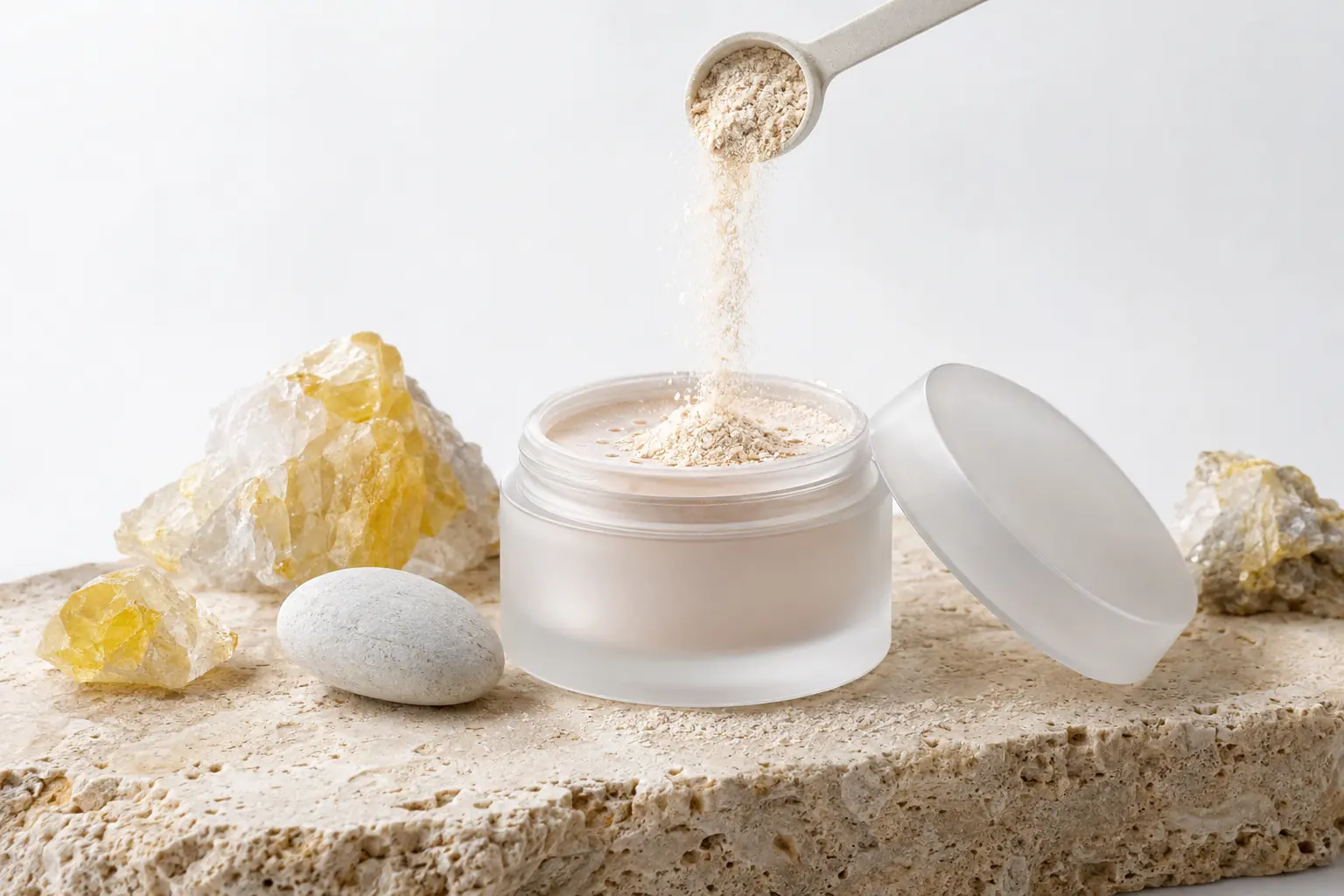
01
What mineral powder is
Mineral powder is a loose product built on talc, mica or other mineral fillers, which brands often position as a lighter alternative to powders with synthetic fillers. In a decorative format, mineral powder is brushed on in a thin layer to mattify and lightly tint skin without a heavy feel; demand for this format rests largely on a "minimal ingredient list" marketing promise.
02
Fillers and colorants in the formula
Annex III entry 59 of Regulation (EC) No 1223/2009 permits Talc with no specific concentration limit — talc or mica-based fillers form the base a mineral powder is built on, including a "talc-free" mineral formula built on other mineral fillers. Shade and opacity come from Iron Oxides (CI 77491, CI 77492, CI 77499) and Titanium Dioxide (CI 77891), permitted under Annex IV as colorants for a mineral-makeup base. Mica (CI 77019), used for a shimmering finish, is not included in the Annex IV colorant list and instead falls under the general product-safety duty of Article 3 of the Regulation.
03
Nanomaterials and UV filters
If a mineral powder is marketed with an SPF claim, a common angle for this format, Annex VI restricts nano-form Titanium Dioxide and Zinc Oxide from any application that may lead to lung exposure by inhalation. A nano-grade mineral pigment is regulated as a colorant under Article 14 and is exempt from the Article 16(2) six-month notification only if its nano form is expressly listed in Annex IV, which currently covers only Carbon Black (nano), CI 77266.
04
What AKTO offers
AKTO already fills a loose mineral powder built on kaolin, calamine and plant-extract fillers for before/after hair-removal skin care, into a jar of about 100 g, and develops decorative facial mineral powders to a brand's order on that same loose-mineral filling process. The minimum order for a new private-label line starts at 50 kg. Production runs under combined certificate No. 44600111204 (ISO 9001:2015 and ISO 22000:2018 (HACCP)) and ISO 22716 (GMP). AKTO documents the balance of matte and shimmering mineral components in its own development protocol, so a brand gets the same result in every subsequent jar of mineral powder.
05
Getting started
A brand submits a brief with the desired shade, shimmer level and whether an SPF claim is wanted; AKTO matches fillers and colorants to the Annex III and IV lists, checks mica under Article 3 and nano-grade pigments under Article 14, and prepares documentation for the chosen market. Every mineral-powder project starts by balancing matte and shimmering mineral components to the brand's brief. See also: Makeup Base & Complexion, Loose Setting Powder, Pressed Powder and Fixing Powder.
Frequently Asked Questions
Does AKTO manufacture mineral powder?
Why is mica not on the Annex IV colorant list?
What is the base filler of a mineral powder?
What is the minimum batch for a new private-label mineral powder?
Expert review
Reviewed by
 Illia Mariutsa
Researcher, organic chemistry
Google Scholar Anastasiia Bespalova
Paediatric orthopaedic and trauma surgeon
ORCID
Standards we work to
 ISO 22716 (GMP)
 ISO 22000 (HACCP)
 Regulation (EC) No 1223/2009
 Directive 2002/46/EC
 Halal
Why AKTO
- Experience filling loose mineral powders into a jar of about 100 g
- Decorative mineral powder development to a brand's order
- Fillers and colorants checked against Annex III and IV of Regulation (EC) No 1223/2009
- MOQ from 50 kg for a new line
- Certified to ISO 9001:2015, ISO 22000:2018 (HACCP) and ISO 22716