
Private Label
Loose Setting Powder
AKTO develops and manufactures loose setting powder to a brand's order, pairing formula development with loose-powder filling.
- ISO 22716 GMP
In brief
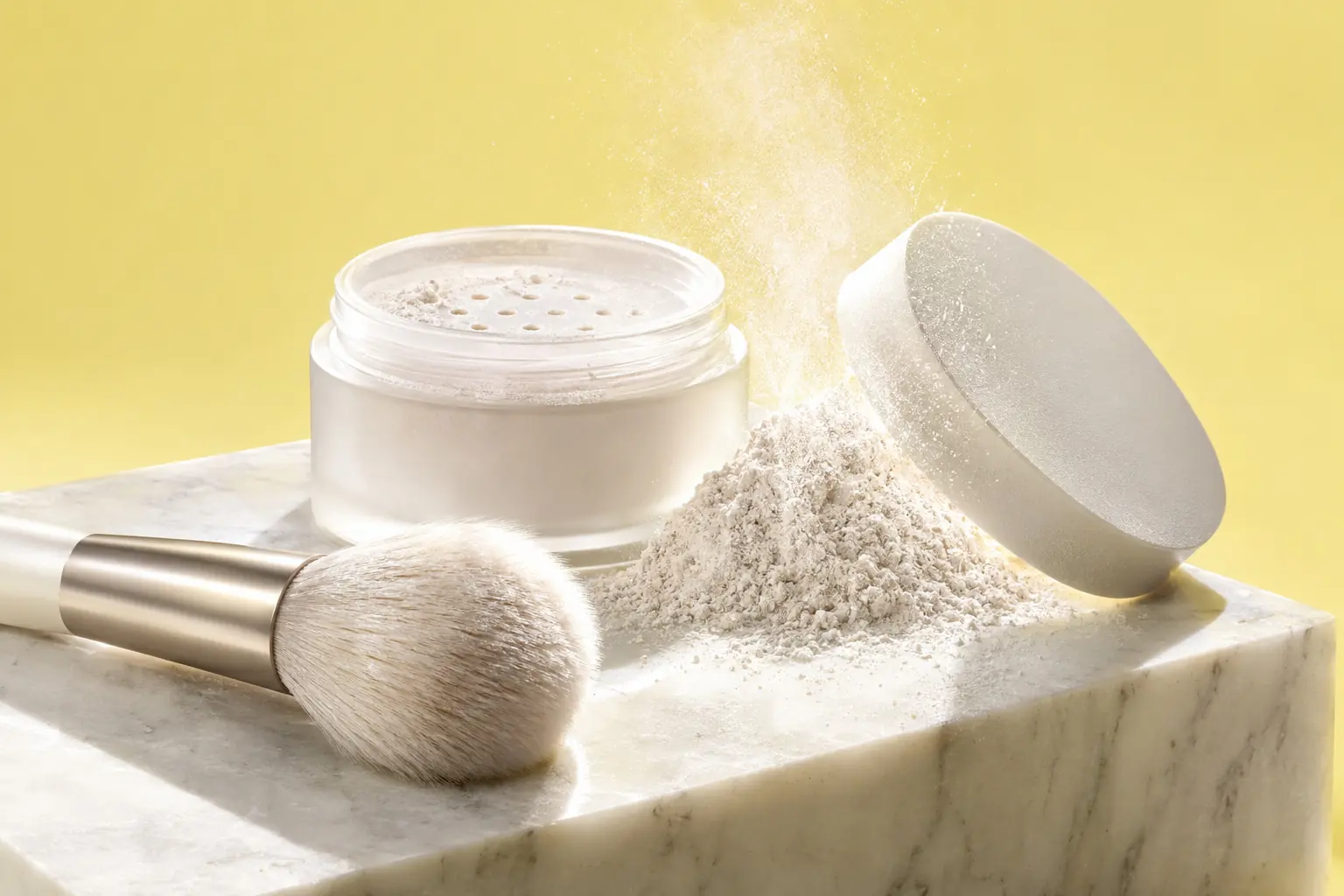
Loose setting powder sets makeup and mattifies skin with a thin layer of finely milled powder, applied with a brush or sponge. AKTO develops and manufactures loose setting powder to a brand's order, drawing on its emulsion, cream and liquid lines together with its loose-powder filling experience. The base filler is talc, permitted under Annex III of Regulation (EC) No 1223/2009, with colorants checked against Annex IV.
01
What loose setting powder is
Loose setting powder is a finely milled powder used to set makeup and mattify skin with a thin, sheer-to-translucent layer; unlike a pressed powder, it is never compacted into a pan but is filled into a sifter jar or dispenser. A brand adds loose powder as the final step of a makeup routine, so the texture has to stay light and avoid a cakey look under camera lighting.
02
Talc and colorants in the formula
Annex III entry 59 of Regulation (EC) No 1223/2009 permits Talc (hydrated magnesium silicate) in cosmetic products with no specific concentration limit, other than the label warning "keep powder away from children's nose and mouth" required specifically for powdery products aimed at children under 3. Opacity and shade in a loose powder come from Titanium Dioxide (CI 77891) and Iron Oxides (CI 77491, CI 77492, CI 77499), permitted under Annex IV subject to the purity criteria of Directive 95/45/EC; Annex III entry 321 additionally caps pigmentary titanium dioxide at 25% in face products in loose powder form when 1% or more of its particles have an aerodynamic diameter of 10 micrometres or less.
03
Nanomaterials and UV filters
If a loose setting powder carries an SPF claim, Annex VI restricts Titanium Dioxide (nano, entry 27a) and Zinc Oxide (entries 30 and 30a) from any application that may lead to lung exposure by inhalation — a condition directly relevant to an airborne loose-powder format. When a nanomaterial is present, Article 19(1)(g) of the Regulation requires the word "(nano)" in the list of ingredients.
04
What AKTO offers
AKTO develops and manufactures loose setting powder to a brand's order, pairing its stated emulsion, cream and liquid formats with its experience filling loose powders into a dispenser or jar. The minimum order for a new private-label line starts at 50 kg. Production runs under combined certificate No. 44600111204 (ISO 9001:2015 and ISO 22000:2018 (HACCP)) and ISO 22716 (GMP). AKTO records a loose powder's milling fineness alongside its mattifying level in the development protocol, so the brand signs off on both before dispenser or jar filling begins.
05
Getting started
A brand submits a brief with the desired mattifying level, whether an SPF claim is wanted, and the dispenser or jar type; AKTO matches talc and colorants to the Annex III and IV lists, checks nanomaterials under Article 19(1)(g) and prepares documentation for the chosen market. Every loose-powder project starts by matching the powder's fineness to the texture in the brief. See also: Makeup Base & Complexion, Pressed Powder, Mineral Powder and Fixing Powder.
Frequently Asked Questions
Does AKTO develop loose setting powder for a private label?
What warning is required on a powder product for children?
What limit applies to titanium dioxide in a loose powder?
What is the minimum batch for a new private-label loose powder?
Expert review
Reviewed by
 Illia Mariutsa
Researcher, organic chemistry
Google Scholar Anastasiia Bespalova
Paediatric orthopaedic and trauma surgeon
ORCID
Standards we work to
 ISO 22716 (GMP)
 ISO 22000 (HACCP)
 Regulation (EC) No 1223/2009
 Directive 2002/46/EC
 Halal
Why AKTO
- Order-based development of loose setting powder
- Talc and colorants checked against Annex III and IV of Regulation (EC) No 1223/2009
- Nanomaterials checked under Article 19(1)(g)
- MOQ from 50 kg for a new line
- Certified to ISO 9001:2015, ISO 22000:2018 (HACCP) and ISO 22716