
Private Label
Oral Foam
AKTO develops and manufactures oral foam to order on its own lines in Kyiv (Ukraine) and Warsaw (Poland).
- ISO 22716 GMP
In brief
AKTO develops and manufactures oral foam to order on its own lines in Kyiv (Ukraine) and Warsaw (Poland). A foaming surfactant in the formula does not bring the product within the detergent regime of Regulation (EC) No 648/2004, since the finished product remains a cosmetic under Regulation (EC) No 1223/2009. The preservative is benzoic acid or sodium benzoate up to 1.7%. The minimum batch is 50 kg.
01
What oral foam is
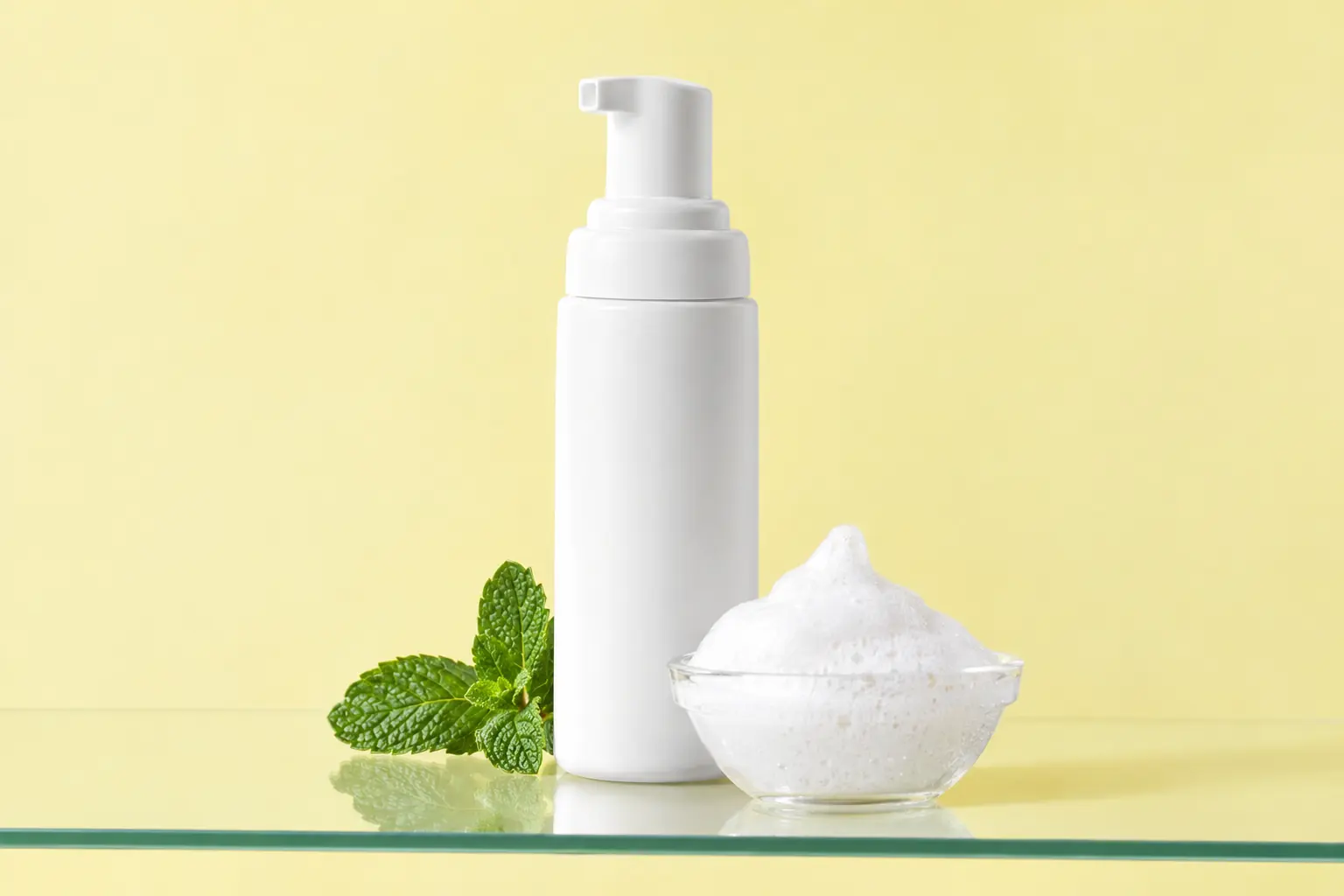
Oral foam is a liquid that turns into foam under a dispenser's pressure for quick cleaning or freshening of the mouth - an alternative to a mouthwash for people who prefer not to hold and swish a liquid for a full rinse cycle. For a brand, it is a niche-audience product: a travel or children's format where a classic liquid rinse is less convenient.
02
Why a foaming agent doesn't make it a 'detergent'
Article 2(6) of Regulation (EC) No 648/2004 defines a 'surfactant' as an organic compound used in detergents, capable of reducing the surface tension of water and forming emulsions or micelles, while Article 2(1) defines a 'detergent' as a substance intended for 'washing' processes - Article 2(2) defines washing as the cleaning of laundry, fabrics, dishes and other hard surfaces. Oral foam, used inside the mouth, is a cosmetic product under Regulation (EC) No 1223/2009 and is not a detergent under this definition; Regulation 648/2004 contains no express cosmetics exclusion, but it also does not cover this category of use.
03
Preservative choice and staying outside CLP
Annex V entry 1 to Regulation (EC) No 1223/2009 permits benzoic acid and sodium benzoate as a preservative up to 1.7% (as acid) in oral products - lower than the 2.5% limit for other rinse-off products and higher than the 0.5% limit for leave-on products. As a finished cosmetic product, oral foam falls outside CLP (Regulation (EC) No 1272/2008) under Article 1(5)(c); CLP classification applies to the raw foaming surfactant, not the finished bottle.
04
What AKTO offers
A claim such as 'freshens' or 'cleans' on the foam's label needs supporting evidence under Regulation (EU) No 655/2013, on the same evidential basis as a liquid-rinse claim in this product family. AKTO offers two production modes: on the client's own raw materials (tolling) or on its own. Pump/dispenser-bottle filling runs on the same liquid lines used for mouthwash, reaching up to 500,000 units a month in Kyiv (Ukraine) and up to 200,000 in Warsaw (Poland). The minimum batch is 50 kg of finished formulation. Production is certified to ISO 9001:2015, ISO 22000:2018 (HACCP; combined certificate No. 44600111204) and ISO 22716 (GMP).
05
Getting started
A brand chooses the dispenser type and the target claim - freshens or cleans; AKTO prepares the formula with the foaming surfactant, a preservative within the 1.7% limit, and documentary support for the claim. This format is a good complement to a mouthwash line for buyers who skip a full rinse cycle. See also: Rinses / Breath, Household, Hygiene & Specialty Care, Breath Freshening Spray and Mouthwash.
Frequently Asked Questions
Is oral foam a detergent under Regulation 648/2004?
What preservative is permitted in oral foam?
Does a 'freshens' claim on oral foam need evidence?
What packaging does AKTO use for oral foam?
 Kateryna Khromykh
 Oleksandra Vovk
Standards we work to
 ISO 22716 (GMP)
 ISO 22000 (HACCP)
 Regulation (EC) No 1223/2009
 Directive 2002/46/EC
 Halal
Why AKTO
- Oral foam developed to order on AKTO's own lines
- Foam stays a cosmetic product, not a detergent under 648/2004
- Preservative capped at 1.7% sodium benzoate for oral products
- Up to 500,000 bottles a month filled in Kyiv (Ukraine) on liquid lines
- MOQ from 50 kg, facilities in Kyiv (Ukraine) and Warsaw (Poland)